Get Full Government Meeting Transcripts, Videos, & Alerts Forever!
Get email alerts on the Presidio Seis topic
No spam. Unsubscribe anytime.
Presidio Trust's Main Post SEIS draws extensive public opposition over scale, historic impacts and process
Summary
The Presidio Trust presented a draft supplemental EIS proposing new public uses and several large building projects in the Main Post, including a proposed contemporary art museum, a lodge and an expanded theater. Hundreds of residents, preservation groups and park advocates told the commission the proposals risk the Main Post's historic integrity, overwhelm transportation infrastructure and were advanced without adequate Section 106 and design study; speakers asked the city to join Section 106 consultation and requested an extended public-comment period.
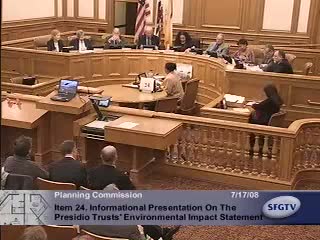
The Planning Commission heard an extended informational presentation from the Presidio Trust on its draft supplemental environmental impact statement (SEIS) for the Main Post District. Michael Boland, the Trust's planning chief, framed the update as an effort to restore the Main Post's public character: rehabilitate historic open spaces, green the Main Parade Ground, create an "Anza Esplanade" pedestrian route and activate the district with cultural and visitor uses.
The Trust's draft SEIS identifies an increment of new construction and demolition that together would modestly increase the Main Post's overall square-footage cap, and it highlights three major new proposals: (1) a contemporary art museum proposal (commonly discussed as the "Camp"/Fisher proposal), (2) a 119-room Presidio Lodge and (3) a revitalized Presidio Theatre or multiplex. The Trust also described transportation-demand-management ideas including shuttle expansion and intercept parking.
City Attorney staff explained that the Presidio's proposals are reviewed under the federal NEPA process (not CEQA) and that the Section 106 historic-preservation consultation under the National Historic Preservation Act is running in parallel; they encouraged the city to participate as a consulting party in Section 106.
Public comment was substantial and overwhelmingly critical. Neighborhood coalitions, the Presidio Historical Association, National Trust for Historic Preservation representatives, National Parks Conservation Association, preservation scholars and residents raised legal and policy objections: they said the Trust's approach risked violating the Presidio Trust Act's limits on new construction (replacement of like-for-like size), threatened the National Historic Landmark designation, underestimated transportation and visitor impacts, and had an abbreviated public-review timetable. Several groups asked the city to join Section 106 consultation and to extend the public-comment window (the Trust had set a deadline in September; neighborhood groups asked for a 90-day extension after Section 106 findings of effect).
Speakers urged alternatives such as adaptive reuse of existing barracks for cultural programming, locating large museums elsewhere in the city, phased rehabilitation of buildings to avoid sudden infrastructure surges, and using the Trust's own capital funds toward historic preservation rather than large new construction. The commission listened, asked about transmittal timing and involvement of city transportation agencies, and encouraged the Trust to work more closely with city departments and neighborhood groups as the SEIS and Section 106 process continue.
The hearing was informational; commissioners did not take a regulatory vote but recorded robust public concern and called for expanded interagency coordination and careful consideration of Section 106 outcomes before the Trust finalizes proposals.