Lifetime Citizen Portal Access — AI Briefings, Alerts & Unlimited Follows
City economists warn office vacancy could cost San Francisco $100M–$200M in property tax over five years
Loading...
Summary
Controller’s office presented models showing downtown office vacancies and rising capitalization rates could reduce property‑tax receipts by roughly $80–$150M by 2026 and possibly $100–$200M by 2028; assessor, appeals board and stakeholders urged continued monitoring and policy consideration.
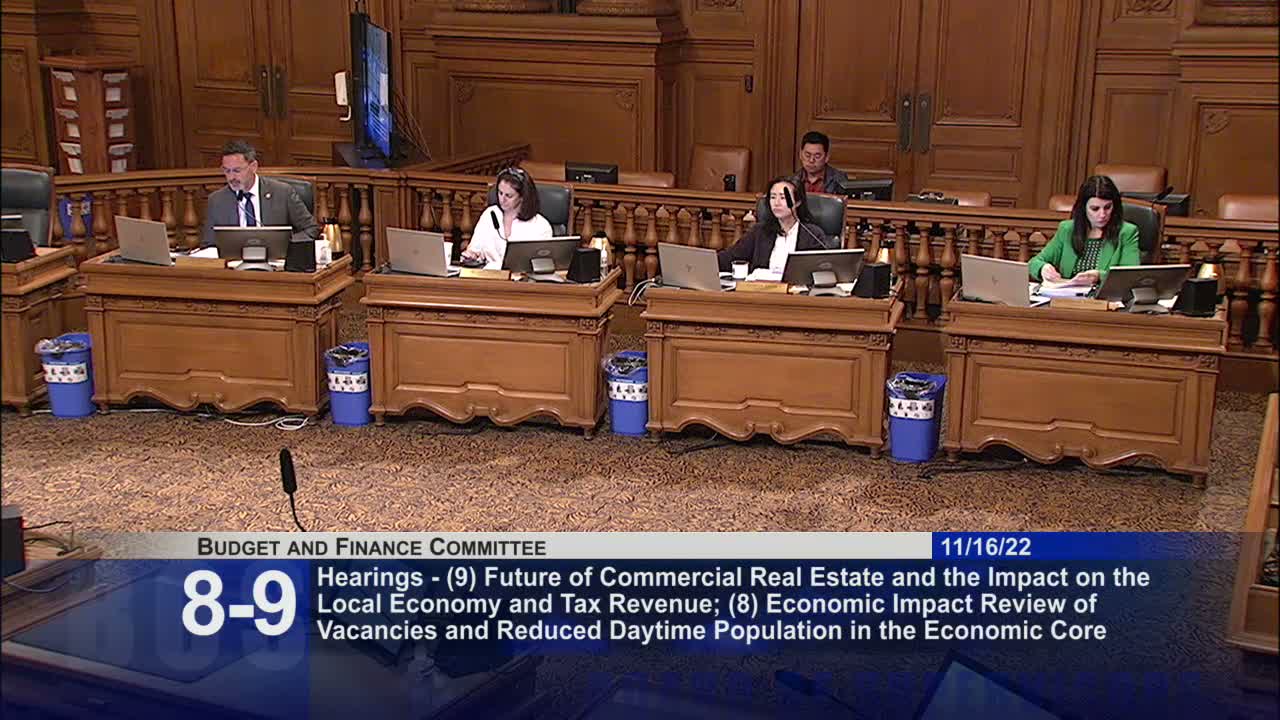
San Francisco city economists and tax officials told the Budget & Finance Committee on Nov. 16 that sustained downtown office vacancy and weaker office income could materially reduce property‑tax revenue and other city receipts over the next five years.
Ted Egan, chief economist in the Controller’s Office, summarized national survey data and market forecasts showing that post‑pandemic work‑from‑home has settled at roughly two to three days per week on average, and that San Francisco’s return‑to‑office rate (~41%) lags many peer metros. Egan said the market is shifting from sublease‑led vacancy to direct vacancy — meaning building owners are receiving less income — and coupled with rising interest rates and higher capitalization rates, that can push down market values and trigger assessment appeals.
Using JLL’s market scenarios to drive a city model, the Controller’s Office estimated property‑tax losses for the office sector from the combined effects of reduced rents and higher capitalization rates. In a moderate ("up") scenario, losses to office property tax could amount to roughly $80–$150 million by 2026; under more pessimistic scenarios, the loss could widen to $100–$200 million by 2028. The Controller emphasized caveats: Proposition 13 assessment limits, long‑term leases and the timing of assessment appeals moderate the speed at which market declines translate to revenue losses.
Assessor‑Recorder Joaquin Torres reviewed the taxable roll (about $330 billion assessed value and roughly $3.9 billion in annual property‑tax revenue) and said downtown commercial property accounts for roughly $69 billion (about 22% of the roll) and downtown office buildings about $47 billion (roughly 14%). Torres and Alastair Gibson of the Assessment Appeals Board reported a surge in appeals: AAB received 2,577 new applications as of Sept. 30, 2022, with downtown neighborhoods accounting for about 35% of appeals. Gibson said, illustratively, if all requested reductions were granted the sample shown could imply a potential tax impact on the order of $182 million (the AAB stressed this represents request totals, not a forecast of settlements).
Controller Ben Rosenfield and supervisors framed the hearing as the first step in a working group the Board will convene with labor, property owners and business stakeholders to identify policy levers and incentives. Supervisors emphasized factors beyond office economics — including street conditions, safety and transit ridership — that influence employers’ and employees’ decisions to return downtown and shape demand.
Committee members asked for an updated five‑year revenue forecast from the Controller, which the office expects to publish in December; supervisors said they will incorporate those figures in upcoming budget guidance and further hearings. Vice Chair Asha Safaei and Supervisor Stephanie — who co‑chair a downtown working group — asked colleagues to study both revenue shortfalls and potential responses ranging from incentives to downtown revitalization efforts. The Committee voted unanimously to continue the hearings and to reconvene with further analysis.