Get Full Government Meeting Transcripts, Videos, & Alerts Forever!
Get email alerts on the Solar Energy Policy topic
No spam. Unsubscribe anytime.
Committee advances GoSolar SF ordinance to align incentives with Clean Power SF, retain low‑income supports
Summary
The Government Audit and Oversight Committee voted to advance an ordinance that would simplify and modestly step down GoSolar SF incentives, integrate the program with Clean Power SF enrollment, and preserve enhanced support for low‑income and nonprofit customers; staff will provide follow‑up on AMI eligibility and outreach plans before the full Board.
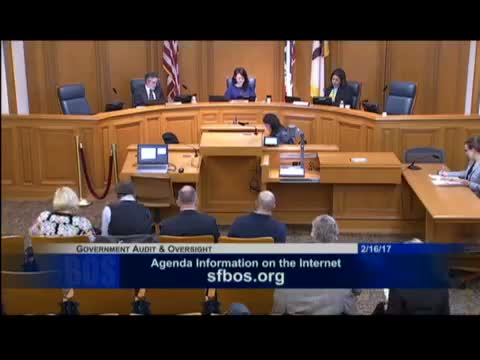
The Government Audit and Oversight Committee on Feb. 16 advanced an ordinance authored by President London Breed that would amend the city’s environment code to adjust GoSolar SF incentives, integrate the program with Clean Power SF and preserve higher incentives for low‑income and nonprofit customers.
The ordinance would simplify the current incentive schedule to a dollars‑per‑kilowatt approach and step down incentive levels to reflect lower solar installation costs. SFPUC staff said the proposed change would reduce a typical residential incentive from about $500 per kilowatt to $400 per kilowatt if the ordinance is approved in April, while retaining an additional low‑income payment of $2,000 where applicable. Lori Mitchell, manager of the Renewable Energy Group at the San Francisco Public Utilities Commission, told the committee that GoSolar SF has paid just over $24,000,000 since 2008, with the majority going to residential installations and a substantial portion to low‑income households.
The measure would also require future GoSolar SF recipients to be Hetch Hetchy Power customers or to enroll in Clean Power SF, the commission’s alternative electricity product. Mitchell said the programs would be marketed together and that the SFPUC has committed not to pre‑enroll additional customers into Clean Power SF if those rates exceed comparable PG&E rates. "We have made the commitment to our commission to not pre‑enroll any additional customers until it's at or below those PG and E rates," Mitchell said. Committee Chair Jane Kim asked whether that requirement would deter low‑income applicants who cannot bear higher monthly charges; Mitchell agreed to consider exceptions and to provide the committee with exact AMI cutoffs and examples of how the program would work for eligible households before the full Board hearing.
Mitchell also described a proposed inverter replacement incentive for earlier low‑income and nonprofit installations as components reach end of life, and noted SFPUC’s coordination with other programs, including the California Solar Initiative’s SASH and financing options (leases and power‑purchase agreements) that can reduce upfront costs for participants.
The ordinance contains a clerical correction to the stated fund balance for the GoSolar SF program; SFPUC staff said the correct balance is $7,275,000, not $11,000,000 as printed in the draft ordinance. President Breed moved the amendments and the committee voted to forward the item to the full Board with a positive recommendation and without opposition.
Next steps: SFPUC staff will provide the committee with precise AMI eligibility levels, applicant income ranges and example scenarios for low‑income households prior to the Feb. 28 Board agenda.