Get Full Government Meeting Transcripts, Videos, & Alerts Forever!
Get email alerts on the Electric Vehicles topic
No spam. Unsubscribe anytime.
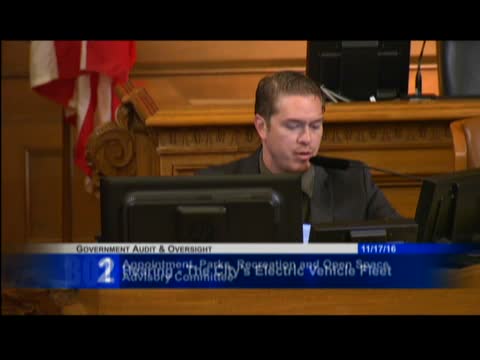
San Francisco committee hears steps to speed municipal electric vehicle procurement
Summary
Supervisors held a Nov. 17 hearing on how the city could move its light‑duty fleet to 100% electric by 2020 and accelerate medium/heavy‑duty electrification. Departments described current fleet composition, charging infrastructure, cost and electrical‑capacity constraints and promised further analysis in six to seven months.
San Francisco supervisors on Nov. 17 held a hearing to explore what it would take for the city to procure 100% of its light‑duty municipal fleet as electric vehicles by 2020 and to accelerate electrification of medium and heavy‑duty vehicles.
Supervisor Katie Tang opened the item and said she had brought the hearing to press the city to take a leadership role on reducing greenhouse‑gas emissions. "I do hope that we can expand ... so that we can all collectively achieve our climate goals," Tang said.
Jesse Denver of SF Environment provided the policy context, citing state and federal procurement goals and California—s zero‑emission vehicle targets. Denver described the city—s existing framework — the Healthy Air/Clean Transportation Ordinance (HACTO) — which applies to municipal light‑duty vehicles and includes exceptions for public‑safety vehicles. "Transportation is a key strategy that will help San Francisco meet its greenhouse gas reduction goals," Denver said, and stressed that EV adoption requires accessible charging infrastructure.
The City Administrator's Office presented a snapshot of municipal fleet use and capacity and recommended further analysis. The office reported approximately 2,754 vehicles in the citywide fleet with 859 light‑duty sedans (509 general‑fund, 350 enterprise); the city currently owns 52 electric sedans and nine electric SUVs. The office said many sedans travel less than 300 miles per month, a usage profile that fits plug‑in hybrids and shorter‑range battery vehicles. City Administrator staff said they expect to complete a more detailed analysis and recommendations within "the next 6 to 7 months" to inform budget decisions.
Public Works fleet manager John Liao described early adoption in his department: "We have 38 electric vehicles in our fleet right now, and we have 19 more that should be delivered in the next about 60 days." He warned that the department is currently at capacity for charging at some facilities and that adding vehicles will likely require costly electrical upgrades.
Departments identified three primary charging use cases — Level 1 for overnight/home-style charging, Level 2 for workplace charging (the city has mostly Level 2 infrastructure), and DC fast charging for high‑duty or public commuter needs — and emphasized managed‑charging and load‑control systems to avoid large electrical upgrades. Presenters said the city has roughly 217 publicly available charging ports at municipal facilities (about 111 at municipal garages and lots, about 25 dedicated to fleet charging) and more than 600 Level 2 charging stations citywide, though not all ports are publicly accessible.
Supervisors asked about contracting timelines and whether the city should pursue leasing, piggybacking on other government contracts, or consolidated buys as current contracts approach expiration in February 2017. City Administrator staff said they are evaluating procurement and lease/purchase options and will consider leveraging existing government contracts.
Supervisor Tang said she will follow up with legislation to reflect the hearing—s goals and the committee filed the hearing for follow‑up as requested. No members of the public spoke on the item.