Get Full Government Meeting Transcripts, Videos, & Alerts Forever!
Get email alerts on the Five Year Financial Plan topic
No spam. Unsubscribe anytime.
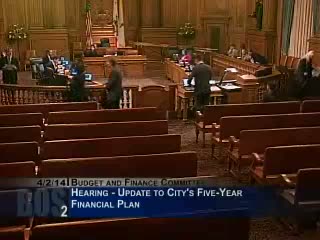
City's five‑year plan shows improving short‑term revenues and longer‑term shortfalls, presenters say
Summary
Controller Ben Rosenfield and the Mayor's Budget Director Kate Howard told the Budget & Finance Committee the city's joint five‑year financial plan projects a roughly $67 million general fund shortfall in 2014‑15, driven by expenditures outpacing revenue growth farther into the horizon and by enterprise risks such as Hetch Hetchy capital needs.
City officials told the San Francisco Board of Supervisors Budget & Finance Committee on April 2 that while the short‑term fiscal outlook has improved, structural pressures and enterprise risks mean shortfalls will grow later in the five‑year projection.
Controller Ben Rosenfield said the joint five‑year financial plan prepared by the controller's office, the mayor's budget office and the Board's budget analysts projects approximately a $67,000,000 general fund shortfall for fiscal 2014‑15, growing in later years if ongoing solutions are not identified. Rosenfield said revenue growth continues but that projected expenditures outpace revenue farther out in the period.
Kate Howard, the mayor's budget director, said the updated assumptions reduced earlier shortfall projections because of better current‑year revenues and starting fund balance. The budget office added conservative assumptions for wages and benefits, projected health and dental increases of about 5% per year, and earmarked funds for major IT investments (including projects the office estimated at about $70 million each).
Rosenfield and Howard highlighted revenue drivers: a projected $79 million increase in property tax next year, strong hotel tax growth, a projected $31 million increase in business taxes, and a record transfer tax forecast of roughly $233 million in the current year. The officials cautioned transfer tax is volatile and projections soften in the third and fourth years.
Howard flagged enterprise vulnerabilities, most notably at the Public Utilities Commission. She said new information about the Hetch Hetchy mountain tunnel raised an unexpected capital need that could range from $600 million to $700 million and that transmission and distribution negotiations with PG&E could materially change the power enterprise's cost structure. Supervisor Scott Wiener described the power enterprise's situation as deeper than a single capital project and urged efforts to stabilize the PUC's customer base and capital plan.
Committee members asked about the timing and assumptions for labor negotiations, the impact of San Francisco General Hospital rebuild on staffing and one‑time costs, and longer‑term implications if enterprise development (for example at the Port) were reduced. Rosenfield said the projection assumes no recession in the four‑year horizon and that risk increases farther out.
The committee closed the hearing with no public comment and filed the item; Rosenfield and Howard were asked to provide a forthcoming nine‑month report as the budget season continues.