Get Full Government Meeting Transcripts, Videos, & Alerts Forever!
Get email alerts on the Healthcare Surcharges topic
No spam. Unsubscribe anytime.
Civil grand jury says restaurant surcharges and HRAs leave workers short; city officials differ on whether 2012 amendments fixed loopholes
Summary
The San Francisco civil grand jury found that some restaurants collected surcharges intended for employee health care but did not spend the funds on employees; OLSE, the mayor's office and some supervisors said new 2012 ordinance amendments improve reporting and outreach but resource and verification gaps remain.
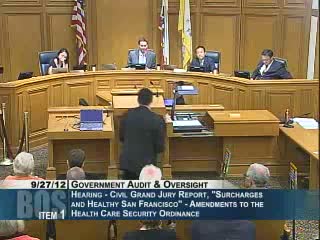
The San Francisco civil grand jury told the Board of Supervisors’ Government Audit and Oversight Committee that city enforcement and employer practices allowed some businesses to collect surcharge money intended for employee health care while reimbursing little or none of it to workers.
Mario Choi, pro tem of the 2011–12 civil grand jury, said the jury’s investigation found it was “really unclear who’s actually benefiting from Healthy San Francisco” and that its survey identified restaurants collecting surcharges yet reimbursing employees little or nothing. The report recommended eliminating health reimbursement accounts (HRAs) in favor of the city option and urged the District Attorney to investigate possible consumer fraud.
Supervisor David Campos, who requested the hearing, said the grand jury and the Office of Labor Standards and Enforcement (OLSE) independently confirmed concerns his office first raised in 2010: employers can restrict HRA usage, workers often do not access the funds, and some businesses collected more in surcharges than they spent on employee health. Campos cited OLSE figures that in 2011 employers allocating $66 million to HRAs reimbursed roughly $11 million (about 17 percent).
OLSE staff summarized their August 2012 report to the committee, saying the department received annual forms from roughly 3,652 employers for 2011 and that reimbursement rates for HRAs were far lower than the city option’s medical reimbursement account (MRA) rate. OLSE said it has begun compliance work, ran a pilot to pursue employers who failed to file annual reports (30 percent of that pilot complied), and has recovered money for workers through enforcement efforts totaling millions of dollars paid to affected employees.
But OLSE and department representatives told supervisors they lack the resources to conduct broad proactive audits and will, for now, largely rely on self‑reported data, complaint‑driven investigations and targeted follow‑up. An OLSE representative summarized the 2011 surcharge data: 172 employers reported imposing health‑care surcharges that totaled about $14.7 million; of those, 101 reported collecting more in surcharges than they spent on health care.
Deputy City Attorney John Giffner told the committee that a business that represents a surcharge is for a stated purpose but uses the funds differently can be liable for consumer fraud. The District Attorney’s office said it has opened a preliminary review and is seeking the grand jury’s underlying documents to evaluate whether a criminal or civil case is warranted, but cautioned that prosecution for broadly worded surcharges could be difficult under the current ordinance language.
The Mayor’s office said it issued an executive directive requiring OLSE to collect additional surcharge information, to do outreach to employees and employers, and to report HRA reimbursement practices. Mayor’s staff said the city supports verification efforts and added resources in the 2012–13 budget for OLSE, but emphasized a “trust but verify” approach given limited staffing.
Restaurant industry representatives warned against banning HRAs or disallowing surcharges, saying such moves could be legally fraught and harm businesses. Public commenters — including workers who described delayed or withheld reimbursements and advocates who called for closing the loophole — urged stronger enforcement or statutory fixes that would require employers to treat surcharge collections as expenditures rather than discretionary funds.
After testimony the committee accepted revised, partially dissenting language to the civil grand jury findings that recognizes the November 2011 ordinance amendments (effective Jan. 1, 2012), directs continued monitoring of 2012 data and OLSE enforcement, and forwards the committee’s response to the full Board of Supervisors. The District Attorney said its preliminary review remains open.
Next steps: OLSE will collect 2012 reporting forms and the committee said it will monitor results and resource needs; the DA will review grand jury materials as available. No new ordinance was adopted at the hearing.