Get Full Government Meeting Transcripts, Videos, & Alerts Forever!
Get email alerts on the Redevelopment Dissolution topic
No spam. Unsubscribe anytime.
Redevelopment dissolution shifts costs to San Francisco general fund, mayor’s budget office says
Summary
City officials told the Budget & Finance Committee that dissolution of the state redevelopment agencies (AB26/27) moves enforceable obligations into successor agency budgets while many neighborhood and workforce programs become general fund obligations, raising multi‑year general fund costs.
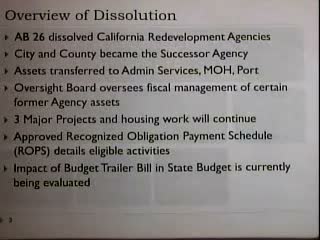
City budget staff told supervisors the state’s dissolution of redevelopment agencies (ABx1 26/27) requires San Francisco to act as successor agency and transfer many redevelopment assets and responsibilities into existing city organizations. Kate Howard, the mayor’s budget director, said enforceable obligations such as debt service and certain major project obligations will continue under a recognized obligation payment schedule, but non‑enforceable neighborhood investment, workforce readiness and some hotel‑tax funded activities can no longer be paid from tax increment and will shift onto the general fund.
Howard identified the three major approved development project areas that will continue — Mission Bay, Transbay and Hunters Point Shipyard — and said administration staff and the oversight board have adopted ROPS to manage enforceable obligations. She outlined immediate successor agency budgets (roughly $140 million in year one) and noted that some tax increment is being recalculated under new state pass‑through formulas, increasing the successor agency’s tax increment request modestly over the next two years.
The mayor’s office of housing and the city administrator’s community reinvestment division will absorb staff and functions formerly financed or executed by the RDA. Howard said the mayor’s office of housing’s budget will grow to address housing obligations including HOPE SF sites and a $30.2 million Choice Neighborhoods grant that remains an enforceable obligation. The administration estimated combined net general fund impacts in the low‑ to mid‑millions across the two-year budget window for non‑enforceable activities and transition costs; budget staff and the controller will provide committee follow‑up on exact tallying of the effect.
Supervisors repeatedly asked how much of the successor work and non‑enforceable program absorption is one‑time versus ongoing. Howard and budget analysts indicated some costs would be one time (using fund balances) while recurring programmatic commitments (workforce readiness, HOPE SF supports) will require ongoing general fund allocations during implementation and future budget cycles.
Next steps: the committee asked housing and budget staff for a department‑by‑department accounting of successor obligations and the package of non‑enforceable activities that the general fund is being asked to cover so supervisors may weigh tradeoffs during the final budget votes.