Get Full Government Meeting Transcripts, Videos, & Alerts Forever!
Get email alerts on the City Revenue topic
No spam. Unsubscribe anytime.
Controller flags $123 million in unsecured federal revenue and warns of a $400M-plus gap next year
Summary
Controller Ben Rosenfield told the Budget & Finance Committee that the mayor—s revenue assumptions are broadly reasonable but that about $123 million in federal revenues and $88 million tied to AB188 remain unsecured, and that the next fiscal year could face a deficit approaching $400 million without additional action.
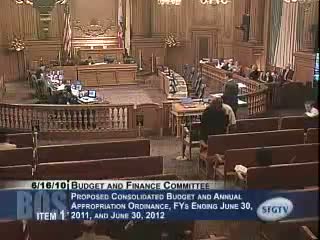
Ben Rosenfield, the city Controller, told the Budget & Finance Committee that the mayor—s proposed 2010-11 budget is generally reasonable but carries significant revenue risk.
Rosenfield said the Controller's office identified roughly $123 million of assumed federal revenue in the mayor—s plan that still depends on federal action, including stimulus extensions and other items. "Either an act of Congress in one case... and in the case of the second and the larger revenue, about $88,000,000 in revenue is assumed from AB188... that process is proceeding, but it does require a federal ruling," Rosenfield said. He also pointed out $19 million of revenues that require local approvals and cautioned that state-level cuts or changes could produce larger losses than the $30 million contingency set in the mayor's plan.
Rosenfield—s office projected that, given expiring one-time federal sources and other factors, the following fiscal year (2011-12) could face a budget shortfall approaching or exceeding $400 million unless additional ongoing solutions are identified. He recommended treating assumed federal and state revenues as uncertain and preserving reserves or contingency measures in case the funds do not materialize.
What the committee did: Members asked Rosenfield and the budget analyst to supply additional detail as departments continue deliberations; committee and staff will revisit revenue assumptions and prepare updated quarterly reports as the state and federal budget processes evolve.
Why it matters: The Controller—s cautions add pressure to the board—s deliberations, because several departmental proposals and labor concessions in the current budget rely on revenues that may not be realized. That elevates the importance of the committee—s follow-up on contingency planning and alternatives.