Get Full Government Meeting Transcripts, Videos, & Alerts Forever!
Get email alerts on the Consumer Protection topic
No spam. Unsubscribe anytime.
SCDCA webinar explains how to file complaints, 2023 complaint totals and referral process
Summary
Scott Cook, communications director for the South Carolina Department of Consumer Affairs, walked listeners through how to file a complaint, timelines and closing categories, 2023 complaint statistics (about 5,700 complaints and $1.25 million recovered), and where SCDCA refers matters beyond its jurisdiction.
Scott Cook, communications director for the South Carolina Department of Consumer Affairs, led a Wednesday webinar explaining how consumers can file complaints with the agency and how SCDCA processes and uses complaint information.
Cook said the agency mediates thousands of complaints each year and that "everything is free," noting SCDCA offers voluntary mediation and referral options depending on whether the agency has regulatory authority over the business. He outlined two main filing methods — the agency's online portal at consumer.sc.gov (recommended) and a paper form that can be mailed — and emphasized that the online portal lets filers track status and communicate with staff.
The webinar set out the agency's complaint timeline: SCDCA aims to process new complaints within two business days, mails the complaint to the business, and gives the business 20 business days to respond. If there is no response, SCDCA sends follow-up notices (a 10-day then a five-day follow-up) before a complaint is typically closed as unsatisfied. Cook said that in 2023 SCDCA's average time to resolution across divisions was about 38 days, with the consumer services division averaging 28 days, the legal division averaging up to 70 days, and the identity-theft unit averaging about 41 days.
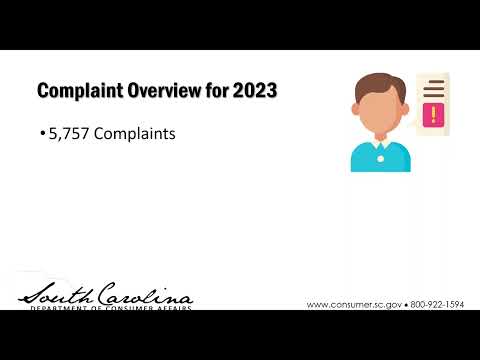
Cook presented 2023 totals and outcomes: SCDCA received just over 5,700 complaints in 2023, up from roughly 4,500 in 2022 — the highest total since 2009. He said the services division handled roughly 4,072 complaints (with about six staff handling intake), the legal division handled about 1,500, and the identity-theft unit handled 207 complaints. Total refunds and adjustments reported for 2023 were $1,250,000 (down from about $1,280,000 in 2022). On closures, Cook said about 59% of complaints were closed as "consumer satisfied" (business response plus consumer deemed it satisfactory) and roughly 17% were closed as "unsatisfied" when businesses did not respond after notices.
Cook described the most common complaint categories in 2023: vehicles (he cited a large increase in vehicle-related complaints), real estate matters (578 complaints, often homeowners association or timeshare issues), and contractors (242 complaints), noting some contractor matters are referred to the Department of Labor, Licensing and Regulation. He stressed that SCDCA's jurisdiction covers goods and services purchased for personal, family or household use, and that it generally cannot take complaints that are business-to-business, individual-to-individual, employment disputes, discrimination (these are referred), or matters already in court or represented by counsel.
On homeowners association (HOA) complaints, Cook explained that state law requires consumers to provide a supplemental questionnaire before SCDCA can process an HOA complaint; incomplete questionnaires commonly lead to complaints being closed as abandoned (he said about 18% of HOA complaints were closed as abandoned in 2023). He directed listeners to the agency's HOA education page (consumer.sc.gov/hoa-ed) and related webinar videos.
Cook reviewed closing categories in detail — consumer satisfied, adequate business response, unsatisfied, referred, duplicate, insufficient merit, abandoned and undetermined — and listed common referral agencies: Board of Financial Institutions (consumer finance), Department of Labor, Licensing and Regulation, Department of Insurance, Department of Public Health, Department of Agriculture, Secretary of State, and the Human Affairs Commission for discrimination claims.
He warned that complaints containing profanity will not be processed, anonymous complaints are not accepted, and that filings and supporting documents may be public records under the South Carolina Freedom of Information Act; he advised filers not to submit sensitive data such as Social Security numbers or account numbers.
As examples of enforcement work that began with consumer complaints, Cook cited a 2015 investigation involving Western Sky Financial (CashCall) that yielded a voluntary settlement with consumer restitution, loan forgiveness and credit restoration, and a 2021 matter involving Kimmy Hearn and Howard Sutter of Upstate Law Group that led to refunds and restrictions on future pension-loan activity. He said multiagency work, including with the Consumer Financial Protection Bureau, produced broader relief in related cases.
In Q&A, Cook told a listener that removing property from an HOA is generally not possible without the HOA's agreement because membership usually attaches at sale via the governing documents, and he encouraged consumers seeking statutory change to contact their state lawmakers. The webinar closed with an invitation to future Wednesday webinars held weekly at 10:30 a.m.
Next steps: the agency's portal at consumer.sc.gov is the primary filing route; consumers with HOA complaints must complete the supplemental questionnaire; discrimination, employer-employee disputes, and matters in active litigation will be referred to the appropriate authority.