Get Full Government Meeting Transcripts, Videos, & Alerts Forever!
Get email alerts on the Fair Funding topic
No spam. Unsubscribe anytime.
Arkansas agriculture officials signal plan to stabilize fair funding after years of ad hoc support
Summary
Department of Agriculture officials told the Senate committee they are working with the governor and a newly formed stakeholder group to present a longer-term funding plan for county, district and state fairs, after decades of allocations from multiple ‘pots’ of money left fair managers uncertain year to year.
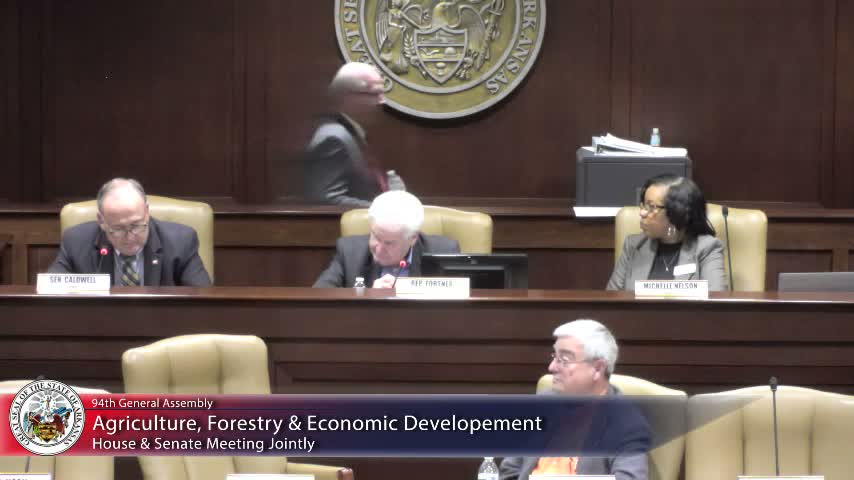
Secretary West Ward told the Senate Agriculture, Forestry & Economic Development Committee that the Department of Agriculture is working with the governor’s office and stakeholders to stabilize fair funding and present a proposal during the upcoming fiscal session.
"We are working on that," Ward said when asked how the department plans to address recurring shortfalls. He noted the legislature approved an additional $178,000 to a restricted reserve last year to restore county and district fair allocations to 2022 levels, and that officials want a single, transparent appropriation line so recipients know what to expect from year to year.
Lacey Bason, president of the Arkansas Fair Managers Association, told the committee that construction funds and other historic sources have become unreliable. "Construction funds are things that we have to have in our local county fairs," Bason said, explaining that many fair managers borrow from banks each year when state support is uncertain.
Weldon Winn, a past AFMA president, described county fairs as economic and educational anchors for rural communities and urged the committee to pursue permanent funding. "We're the fairs and if some of you are from small counties... they're the majority of them are suffering and suffering great today," Winn told members.
Lawmakers pressed the department for specifics on where the money currently sits. Secretary Ward said the construction funds historically came from a restricted reserve or rainy‑day account, while other fair support comes from general revenue in the department’s appropriation. Ward said the department can request that the governor authorize use of restricted funds as part of budget hearings and indicated any permanent solution would ultimately require legislation.
Representative Beatty, citing budget figures discussed in the meeting, summarized the scale: committee members were discussing "probably less than a million and a half dollars" total for the various fair funding lines, a sum he said is small compared with larger appropriations but has outsized local impact.
Members asked that stakeholders be included in the drafting process; Secretary Ward said a stakeholder group has been convened but some fair managers reported not being invited and asked for inclusion. Ward committed to continuing conversations in budget hearings and working toward legislation in the 2025 session.
The committee did not take formal action on funding at the meeting; members indicated support for developing either a budget request or a statutory fix to make fair funding predictable moving forward.