Get AI Briefings, Transcripts & Alerts on Local & National Government Meetings — Forever.
Senate State Agencies committee advances dozens of bills on FOIA, elections, procurement and memorials
Loading...
Summary
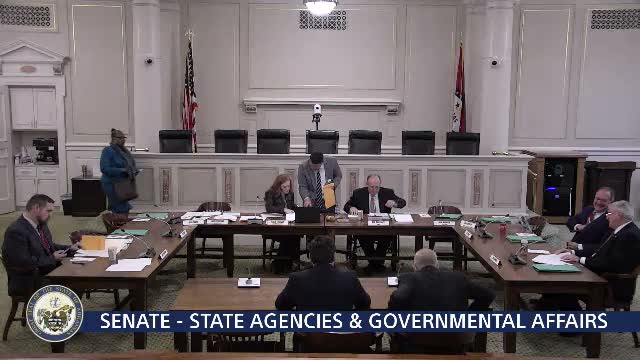
The Senate State Agencies & Governmental Affairs committee on an unspecified date advanced a wide array of measures — from a narrowed FOIA informant exemption and new rules for paid petition canvassers to an amended procurement bill enabling electronic bidding — and passed many by voice vote after debate and public testimony.
The Senate State Agencies & Governmental Affairs Committee heard and moved forward a broad package of bills covering open‑records rules, election law changes, procurement reforms and several commemorative measures.
Among the measures that drew substantial discussion, sponsors advanced an amended FOIA exemption (House Bill 14‑17) that — as amended — allows agencies to withhold the identity of confidential sources when disclosure could endanger life or materially compromise an ongoing investigation. Sponsor testimony and subsequent witnesses, including David Bailey of the Arkansas Democrat‑Gazette, indicated the amendment narrowed the original language and addressed the FOI task force's principal objections; Bailey told the committee the changes “satisfy my issues with the bill.” The committee adopted the amendment and passed the bill as amended.
On election topics, the committee concurred in House amendments to Senate Bill 524 to narrow post‑election audit authority. Daniel Schultz, director for the State Board of Election Commissioners, said the amended language removes discretionary/random equipment audits and retains a requirement that the electronic count be substantiated by the voter‑verified paper audit trail. “What we're really trying to do here is to ensure voter confidence,” Schultz said, arguing the change focuses audits on verifying electronic totals against paper records.
Sponsors also advanced Senate Bill 463, which would require licensing, identification and testing for paid canvassers who circulate initiative petitions. The sponsor framed the bill as a response to documented instances of signature‑gathering fraud, and senators focused questions on exam administration, fees and the statute's criminal penalties for knowing violations.
A large, amended procurement bill prompted the most prolonged public testimony. The amendment would create a public works committee, require an RFQ process for any vendor list used for statewide electronic bidding, set transition steps for municipalities and schools, and permit five authorized avenues for public notice (newspaper, specified website lists, and limited additional channels). Representatives of the Arkansas Press Association and the Arkansas Democrat‑Gazette warned that, even with amendments, the measure risks fragmenting public notices and favoring larger or out‑of‑state vendors; Ashley Wimberly of the press association and Lynn Hamilton of the newspaper expressed strong concerns during the hearing. The sponsor said the amendment adds guardrails (including an RFQ and penalties for vendor misconduct) and advanced the bill with the committee's approval after debate.
Other bills the committee moved included measures to: - Name the 501 Building the Windsor Rockefeller Building (SB652), - Permit sale and limited resale of correctional‑industry furniture to state employees and authorized buyers (HB1941), - Require routine entry of missing‑person biometric and medical records into the national database (HB1881), and - Establish a one‑year study group to examine shielding undercover officers' personal information from public websites (HB1630).
Votes at a glance (committee action stated in the hearing): - House Bill 18‑42 (state employee grievance standards): passed by voice vote. - House Bill 19‑07 (professional wrestling language): passed by voice vote. - Senate Bill 524 (election audit concurrence): concurrence adopted, forwarded. - Senate Bill 457 (land commissioner/technical): passed by voice vote. - House Bill 14‑17 (FOIA informant identity exemption, amended): amendment adopted; bill passed as amended. - Senate Bill 652 (name 501 Building Windsor Rockefeller Building): passed by voice vote. - Senate Bill 670 (election commissioner spouse language cleanup): passed by voice vote. - Senate Bill 498 (casino/Amendment 7 roadmap): failed for lack of motion. - Senate Bill 463 (paid canvasser licensing): passed by voice vote. - House Bill 16‑30 (undercover officers study): passed by voice vote. - House Bill 18‑81 (missing/unidentified persons reporting): passed by voice vote. - House Bill 17‑06 (career service payments): passed by voice vote; sponsor estimated cost about $1,500,000. - House Bill 19‑28 (FOIA modernization/amended): passed by voice vote. - House Bill 16‑98, House Bill 18‑93, House Bill 19‑50, House Bill 19‑41, House Bill 19‑36, House Bill 16‑65, House Bill 16‑66, House Bill 14‑60 (various elections, memorials and administrative updates): advanced or passed by voice votes as recorded in committee.
What comes next: Most measures that passed will move to the full Senate calendar or onward in the legislative process; bills that died or lacked motions will not proceed unless resubmitted. The committee announced it will reconvene the following morning at 8 a.m. for additional business.
Reporting notes: Committee votes were recorded as voice votes in the hearing transcript; several items passed with no roll‑call tally recorded. The article attributes direct quotes to witnesses who spoke on the record at the hearing.