Get Full Government Meeting Transcripts, Videos, & Alerts Forever!
Get email alerts on the Academic Performance topic
No spam. Unsubscribe anytime.
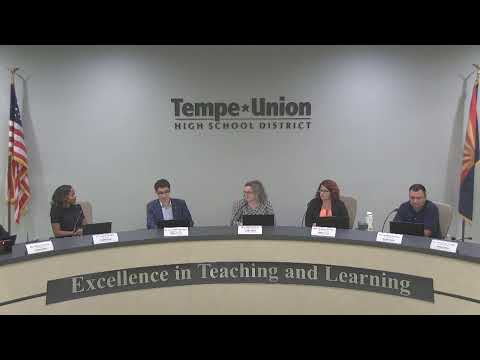
Tempe Union board hears CCRI, ACT and FAFSA progress; board asks for site-level monitoring
Summary
Teaching & Learning presented multi-year CCRI and ACT practice results, noted gains across many schools, highlighted students with zero CCRI points as a priority, and reported FAFSA completion rose despite federal rollout issues; board members asked for more realistic, site-specific progress metrics.
Tempe Union High School District board members on Monday heard a detailed presentation from Teaching & Learning on the district's College and Career Readiness Index (CCRI), ACT practice-test growth and FAFSA completion trends.
Dr. Lehi, Teaching & Learning lead, told the board that the CCRI combines career-readiness and college-readiness indicators and that the district tracks both “red” (career) and “blue” (college) points. He said some schools are already near the CCRI maximum of 22 points, while others must focus on reducing the share of students who earn zero CCRI points. “The CCRI index is determined by these career readiness indicators and college readiness indicators,” Dr. Lehi said.
The presentation showed multi-year increases in average red and blue points and growing counts of students earning seals such as biliteracy, arts and the newer personal finance and civics seals. On FAFSA completion, Dr. Lehi said the district saw notable increases but did not meet an across-the-board 10% annual uplift at every site, in part because the federal FAFSA rollout was delayed and experienced technical problems.
Vice President James urged caution in setting uniform annual percentage goals for FAFSA at every campus and asked staff to propose more realistic, site-specific monitoring: “I just want to say with the FAFSA, I'm just looking at our goals and thinking of how we can move forward with goal setting, to make sure we're really using, you know, setting realistic goals,” she said. Member Barraza noted CCRI points make up about 20% of the state's letter grade and emphasized the importance of these measures for both accountability and student opportunity.
Teaching & Learning described analytic tools that allow staff and teachers to pivot data by teacher, period and subgroup (including special education and English learners) and to identify students who improved or declined between the fall ninth-grade and tenth-grade practice tests. Dr. Lehi highlighted classroom-level pivot tables that can list student names and test performance to guide targeted interventions.
The board requested ongoing, interim progress reports and suggested framing CCRI and FAFSA as district-monitoring priorities with realistic, site-level benchmarks rather than identical percentage goals across all campuses. No formal action was taken beyond discussion and direction to continue progress monitoring.