Get Full Government Meeting Transcripts, Videos, & Alerts Forever!
Get email alerts on the Transportation topic
No spam. Unsubscribe anytime.
Council hears Kimball Junction EIS update; staff outline trade‑offs between split‑diamond and UDOT widening options
Summary
County staff updated the Summit County Council on alternatives in the Kimball Junction environmental impact statement, showing the split‑diamond design would capture more local trips while UDOT’s widening approach is lower cost and offers greater interstate throughput. Council urged attractive pedestrian crossings as a local betterment and noted UDOT now expects EIS conclusion in summer 2025.
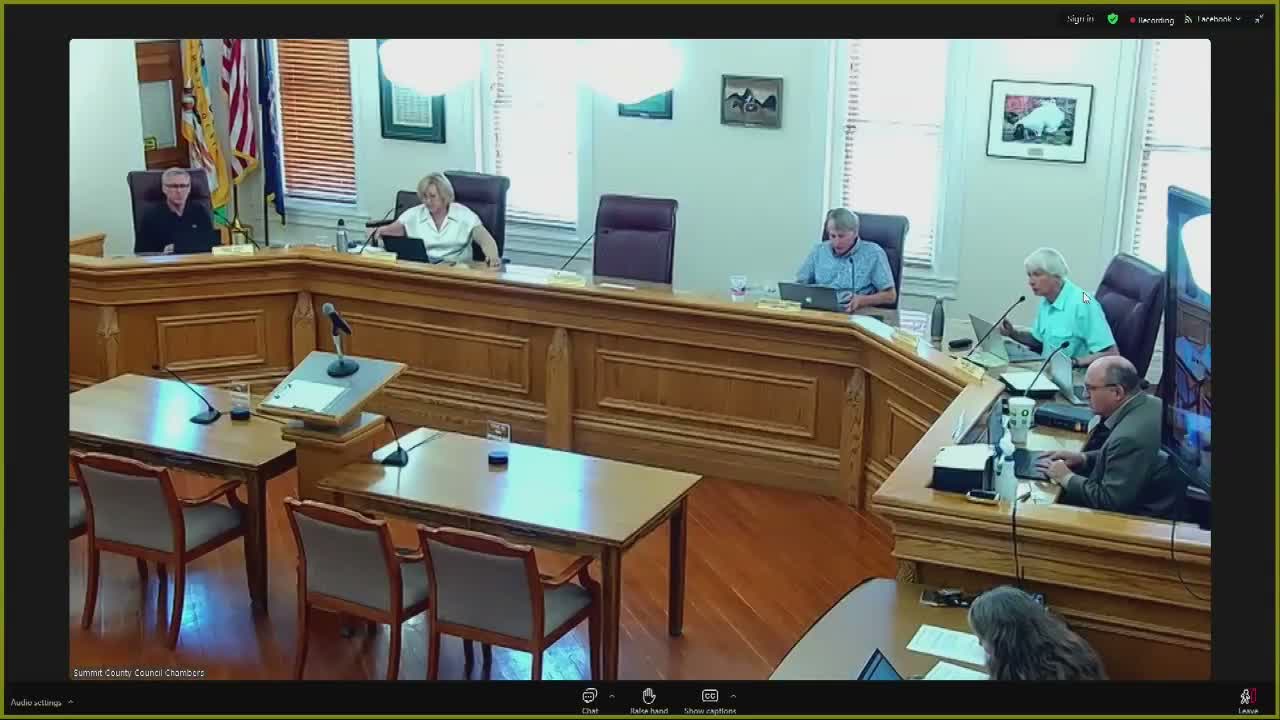
County staff briefed the Summit County Council on the status of the Kimball (Kimball/Kimbell) Junction Environmental Impact Statement on Aug. 28, describing three engineering alternatives and asking for council guidance ahead of a UDOT presentation later this year.
Carl Miller, a county project lead, said current weekday peak‑hour counts show roughly 30–40% of trips in the junction area stop locally for gas, food or shopping. Staff models show growth increases local capture; the split‑diamond (Alternative A) could raise local stops to about half of trips in some peak‑period scenarios. “Alternative A provides better bus rapid transit speeds and redundancy,” Miller said, adding that the split‑diamond would allow traffic to bypass a blocked interchange in some cases.
Brandon Brady, the county engineer, walked the council through Alternatives A, B and C. He said UDOT screened the fly‑under options (variants of B) out for feasibility reasons and that Alternative C — a more typical UDOT widening with added turn lanes — has the lowest construction cost and provides the best interstate throughput. “Each alternative does different things; C provides more throughput and is lower cost, A gives transit and redundancy advantages,” Brady said.
Council members pressed staff about pedestrian safety and the look and function of crossing treatments. Several members said they prefer an above‑grade pedestrian overpass or an architecturally treated bridge rather than a chain‑link overpass. Staff said UDOT’s screening metrics emphasized walk times; overpasses increase ramp lengths and total crossing time and were therefore screened out in the EIS analysis, but staff said locally funded “betterments” — upgraded bridges, promenades or landscaped ramps — could be pursued by the county as add‑ons.
Staff also reviewed schedule implications: UDOT has pushed the EIS conclusion to summer 2025 and staff said a Record of Decision will be needed for STIP inclusion. County staff asked the council whether it preferred to endorse an alternative now or provide general guidance; several council members recommended working with UDOT to preserve options and to pursue pedestrian betterments as a local priority.
The council did not take a formal vote on a preferred alternative at the meeting. Staff said they expect UDOT to present a formal draft to the council and public in late fall or early winter.