Get Full Government Meeting Transcripts, Videos, & Alerts Forever!
Get email alerts on the Conservation Easement topic
No spam. Unsubscribe anytime.
Advisory committee approves funding for Wire Ranch easement, seeks contractual water assurances
Summary
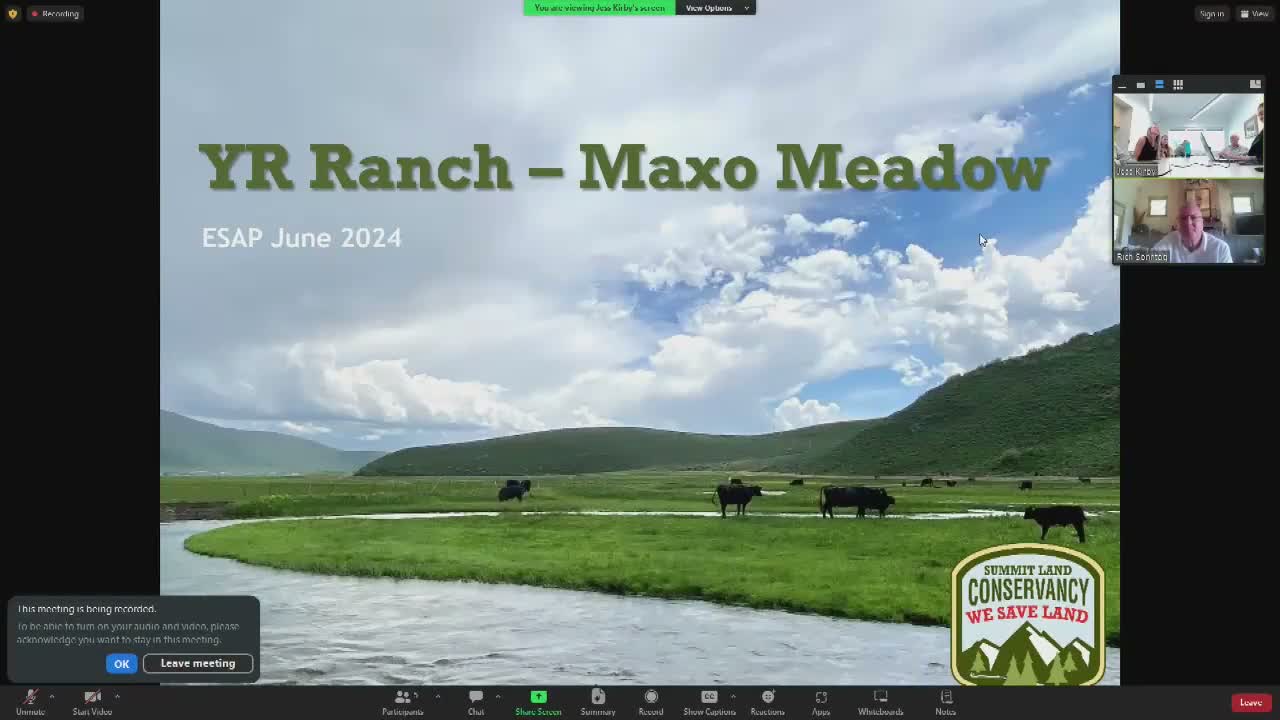
The Eastern Summit County Agriculture Preservation and Open Lands Advisory Committee approved funding to protect the 60-acre Wire Ranch (also called YO Ranch Maximiliano/Max Oak Meadow) with a conservation easement, contingent on contractual assurances that irrigation water will continue to be applied to the property.
Members of the Eastern Summit County Agriculture Preservation and Open Lands Advisory Committee voted at a work session to approve funding for a conservation easement on the Wire Ranch (also referred to in the presentation as YO Ranch Maximiliano or locally Max Oak Meadow), contingent on contractual language ensuring irrigation water remains applied to the property.
Robin Lyons of Summerland Conservancy presented the proposal, saying the property is about 60 acres, supports roughly 33 head of cattle and has been in the family for decades. "It's been in the family for over a hundred years," Lyons said, later noting the ranch has been in Gerald's name for about 75 years and contains no buildings. Lyons described local environmental values the easement aims to protect, including the Camas Valley's unique soils (referred to in the presentation as "Kovich Totsband loams") and high transmissivity in the local aquifer, and she cited wildlife and fish passage values along Beaver Creek.
Lyons also summarized the financing plan for the easement: an appraisal and purchase price were reported at $1,020,000; Summerland Conservancy said it has been awarded 50% of the easement value through the RCPP Headwaters Initiative and is applying to ESAP for 10% (stated as $102,000), with additional requests to OSAC and local fundraising to make up the balance.
Committee members focused much of the discussion on irrigation and water rights. One member asked whether the land's water comes from sub-irrigation or diversions; Lyons replied that the property uses diversions and springs and that water is delivered through a mix of shares tied to different systems, naming Smith and Moore, the State of Utah, and the Weaver River Water Users Association. Lyons said that because the conservancy and property have complex, shared water interests it is not possible to assign a single water-right share to the parcel, but that the conservation easement and an operating agreement can require the land be irrigated and that staff and legal counsel will draft contract language to secure ongoing irrigation.
Committee members said such contractual assurances were essential. One member moved to approve the funding "subject to that condition" — meaning a contractual or operating-agreement obligation to apply irrigation to the property — and another member seconded. The motion passed on a voice vote; the transcript records ayes but does not include a roll-call tally.
Jess, a staff member, said she will meet with Kate Salomeier (the conservancy's vice president for conservation counsel, identified in the presentation) next week to confirm whether the requested contractual arrangements can be completed. "If that's something that can't be done, I'll let you know. But if you don't hear from me, then we'll just assume that we're going forward," Jess said.
The committee did not record further conditions or a formal accounting of vote counts in the transcript. Next steps in the record include conservancy counsel drafting contract language and staff following up; committee members requested that final funding approval be contingent on those assurances being in place.