Get Full Government Meeting Transcripts, Videos, & Alerts Forever!
Get email alerts on the Budget topic
No spam. Unsubscribe anytime.
Grand County budget workshop: staff recommends $1M budget cushion, debates TRT priorities and EMS ambulance request
Summary
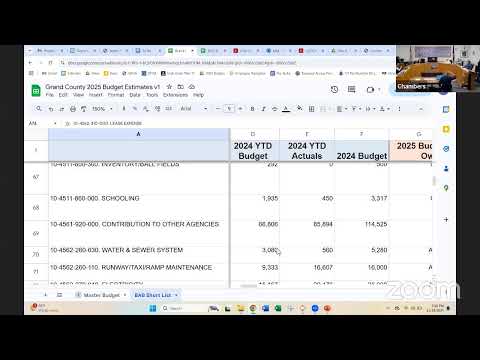
At a Nov. 18 budget workshop commissioners reviewed a conservative revenue forecast and a staff recommendation to budget a $1,000,000 surplus cushion. Major debates included TRT/TCAP spending shifts, a request to help pay for an EMS ambulance (~$350,000), a proposed GCAT rebrand and paid-media increase, and staff proposals for new positions and reclassifications.
Grand County commissioners spent the bulk of a Nov. 18 special workshop reviewing revenue projections, staffing requests and tourism‑tax priorities while seeking options to close a multihundred‑thousand‑dollar gap in the tentative 2025 budget.
Revenue and surplus: Budget staff presented a revenue forecast based on a three‑year moving 12‑month total, projecting roughly $17 million for county revenues in 2025. Staff recommended increasing the assumed budgeted “surplus” (an historical cushion used when opening the budget) from $800,000 to $1,000,000; commissioners gave general support to the $1,000,000 planning assumption but asked staff for follow‑up analysis and documentation before final action. Commissioner Kevin Walker framed the revision as a pragmatic smoothing technique; one commissioner cautioned against treating the assumption as a promise to spend.
New positions and reclassifications: HR presented ranked new‑hire requests and reclassification proposals. Commissioners favored grant‑funded hires (for example, a five‑year fuels‑reduction coordinator and invasive‑species technician) and signaled a preference to prioritize lower‑cost reclassifications over higher‑cost new general‑fund positions while retaining a targeted, part‑time engineering technician on a watch list.
TRT, promotional spending and GCAT: The Tourism Council (TCAP/GCAT) presented two budget models: a conservative, flat model and a higher‑spend model that would add paid media and a rebrand. Staff said the current tentative budget includes about $1.3M for paid media and roughly $775K for a rebrand/consultant; a TCAP letter recommended additional promotion funded from reserves. Tourism staff said prior campaigns produced measurable returns on ad spend and that the office can scale campaigns if the commission opts to inject more funds. Commissioners debated using TRT reserves, the statutory reserve cap, and whether to commit to more promotion now or hold reserves for future flexibility; several commissioners supported a modest, measurable increase tied to strict ROI reporting.
EMS ambulance funding request: EMS representatives explained they financed two replacement ambulances because procurement lead times are long. The initial request was to help pay for ambulance acquisitions; staff and EMS clarified the remaining ask would cover about one ambulance at approximately $350,000. EMS representative said the TRT or mitigation reserves could be used to pay financing payments; commissioners expressed reluctance to commit general‑fund resources in an already tight year and suggested options including a partial one‑time contribution from surplus or asking EMS to pursue a dedicated health‑care sales tax at the ballot. Andy Smith of EMS explained the purchases, saying an ambulance would be about "$350,000," and urged commissioners to consider the request as a one‑time capital contribution to amortize over financing.
Interest allocation for invested reserves: Finance staff proposed a draft policy to allocate interest from pooled investments to funds based on fund balances and statutory rules, recommending the commission retain discretion over whether to allocate interest to funds whose balances are largely general‑fund derived (e.g., capital projects, stormwater mitigation, health insurance). Staff said the tentative budget assumes the proposed allocation and that adopting the policy formally would change the distribution of roughly $400,000 in interest in the current estimates.
Next steps: Commissioners asked staff to prepare a consolidated 'horse‑trading' list of candidate cuts and to provide the requested follow‑up analyses (detailed justification for the $1M assumption, comparative data for elected‑official salary proposals, reclassification cost totals, and TRT reserve balances/limits) before making final decisions at a follow‑up session.