Get Full Government Meeting Transcripts, Videos, & Alerts Forever!
Get email alerts on the Jail Policy Programs topic
No spam. Unsubscribe anytime.
Franklin County approves jail policy manual and MOAs for inmate programs
Summary
The fiscal court approved a new Franklin County Regional Jail policy manual and authorized memoranda of agreement to run an SAP substance‑abuse program and participate in DOC‑approved classes under House Bill 556; the court also approved roadside inmate work crews and a generator maintenance contract with a limit on automatic renewals.
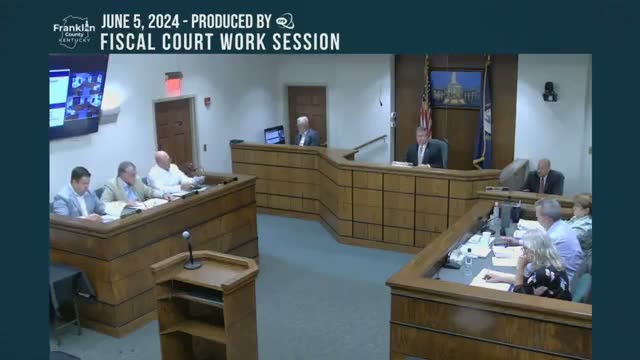
The Franklin County Fiscal Court on a May work session night approved a new jail policy and authorized several contracts and memoranda of agreement to expand in‑jail programs and routine maintenance.
Judge Miller and jail administrators presented a substantially revised Franklin County Regional Jail policy and procedure manual, which the jail task force adapted from national and regional model policies. The court voted to approve the manual as a resolution — a form the magistrates noted could be amended later if needed.
The court also authorized a memorandum of agreement with the Kentucky Justice and Public Safety Cabinet, Department of Corrections, to establish an SAP (substance‑abuse prevention/treatment) program at the Franklin County Regional Jail. Ron, who presented the contract, said the facility has an occupancy certificate for 95 beds and that the state will initially provide placements at lower capacity while the program proves operational readiness: “We have received an occupancy certificate of 95 for the facility itself,” he said, and added the state will phase placements (starting with shorter placement windows) until capacity grows.
Ron described House Bill 556 as a funding vehicle for DOC‑approved classes and said program revenue from that bill is modest at first: “This bill … we believe that it'll bring in about $10,000 a year,” he said. Court members discussed the fact that the jail budget had included a higher revenue estimate; magistrates agreed to adopt the budget as presented and amend it later if the state allocation and enrollment change.
In separate but related actions, the court approved a continuing roadside inmate work‑crew agreement with the Kentucky Transportation Cabinet that the presenters described as long‑running and community beneficial; Ron said the crews are typically three to four participants supervised by staff, and the contract funding helps offset supervision costs.
Magistrates also approved a yearly maintenance contract with W.W. Williams to service two jail backup generators for $1,900 per year, and specifically instructed county staff to negotiate contract language to limit automatic renewals to a shorter term (the court settled on administrative guidance not to allow more than four total years of automatic renewal without returning to the court).
The promotions and personnel business concluded the item: the court confirmed the promotion of Kelsey Torres Esquada from deputy jailer to sergeant after a testing and interview process.
The court approved these items by voice/roll calls during the meeting’s voting session; where revenue estimates for the SAP program differed from earlier budget abstracts, officials said they would amend the budget if the state allocation increases.
The court left room for additional revisions: members asked staff to circulate the redlined policy changes and to make the automatic‑renewal language explicit in the generator contract before final signature.