Get Full Government Meeting Transcripts, Videos, & Alerts Forever!
Get email alerts on the Ugia Damages Cap topic
No spam. Unsubscribe anytime.
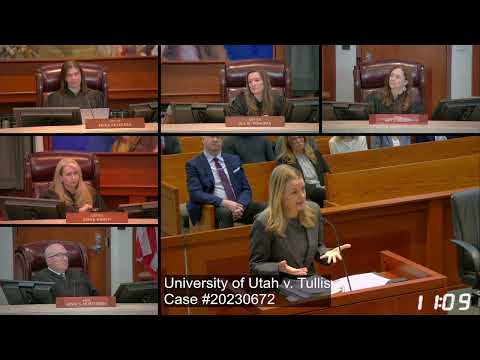
Utah Supreme Court hears arguments over whether 1989 Condomarine limits modern UGIA damages cap
Summary
At oral argument in University of Utah v. Tullis, counsel disputed whether the court's 1989 Condomarine plurality still bars application of the Utah Governmental Immunity Act damages cap to medical-malpractice claims against university-affiliated providers. The justices probed statutory changes, reliance interests and the Board of Examiners'excess-claims procedure.
The Utah Supreme Court on oral argument Monday heard competing claims about whether the court's 1989 Condomarine decision continues to prevent application of the modern Utah Governmental Immunity Act (UGIA) damages cap in malpractice suits involving university-affiliated caregivers.
"This appeal is about whether a single case, Condomarine v. University Hospital decided in 1989 is alone sufficient to invalidate a statute as unconstitutional," Amy Sorensen, counsel for the University of Utah, told the court, arguing Condomarine is a limited, plurality, as-applied holding that later doctrinal and statutory changes undercut its precedential weight. Sorensen pointed to the 2004 repeal and reenact of the UGIA and amendments after 2017 that index the cap to consumer and medical-cost measures as material differences.
Mark Yohallam, counsel for the Tullis family, countered that Utahns have relied on Condomarine for decades and that the case remains a workable rule of decision. "Utahns like the Tullises are entitled to rely on clear, workable rules of law that have been applied for 35 years," Yohallam said, urging the court to require a challenger to show why precedent should be abandoned.
The argument centered on two linked legal questions: whether changes in statutory text and the court's post-Judd jurisprudence (decisions such as Judd, Bingham and Gowans) mean Condomarine no longer controls, and which party bore the practical burden at summary judgment to establish whether the modern statute applies.
Sorensen told the justices the modern UGIA differs from the 1989 statute in several ways: the earlier cap was a fixed $100,000 (later $250,000), while the current statute was restructured in 2004 to begin at about $550,000 and, in 2017, to include indexing tied to medical-care and medical-services costs as well as the consumer price index. She said the 2017 changes and the statute's built-in excess-claims process would mean plaintiffs have a statutory pathway to seek payment of amounts above the cap via a special master and the Board of Examiners, an administrative overlay that, she argued, preserves meaningful remedies even when a jury award exceeds the cap.
Yohallam and other justices pressed whether that Board-of-Examiners route is an adequate substitute for full recovery and whether it has been used in modern practice; Sorensen acknowledged gaps in the record and said the university had not fully litigated those procedures below because the Tullises did not press a constitutional challenge to the current statute in the district court. The university's position, she said, was presented at summary judgment and anticipated Condomarine-based arguments but did not receive the detailed fact development that a direct constitutional attack would require.
Several justices framed the dispute as a question of practical consequence: if the court treats Condomarine as barring any cap for university-affiliated malpractice, then a future jury verdict above the statutory cap could be enforceable in full against the university absent a later adjudication. Yohallam emphasized reliance: hospitals, doctors, insurers and patients have made choices over decades in light of Condomarine-era precedent.
The court also debated procedural posture. Some justices pressed whether plaintiffs had waived the opportunity to develop discovery to show the modern statute remains unconstitutional; the university replied that the fact-discovery deadline had passed and that a request for additional discovery (a Rule 56(d)-style plea) was not properly preserved.
The justices posed hypotheticals about a $2 million jury award and whether the statutory reduction and a subsequent Board-of-Examiners petition would leave plaintiffs without effective relief. Sorensen acknowledged she could not answer every question about how the Board would exercise discretion from the lectern, saying those matters "deserve complete and thorough briefing, by parties in a district court first and then here." Yohallam replied that many Utah citizens and litigants have relied on Condomarine'and that overturning or restricting it without a fuller record would harm reliance interests.
Oral argument concluded without an immediate ruling. The justices repeatedly returned to two points: (1) whether later case law has changed the doctrinal framework enough to render Condomarine nonbinding, and (2) whether the factual and statutory record in this interlocutory appeal is sufficient to resolve the constitutional application of the modern UGIA. The court also questioned whose burden it was at summary judgment to show that Condomarine does not control where the statute and jurisprudence have changed.
The court adjourned after counsel discussed whether discovery requests remained pending; the university said they were not. The justices did not announce a decision at the argument. The case will await the court's written opinion, which will resolve whether the modern, indexed UGIA damages cap applies in the Tullis family's pending malpractice claims and, if so, whether the Board-of-Examiners/excess-claims process is a constitutionally adequate alternative remedy.