Get Full Government Meeting Transcripts, Videos, & Alerts Forever!
Get email alerts on the Criminal Venue Statute topic
No spam. Unsubscribe anytime.
Utah Supreme Court hears dispute over whether 'district' in venue law means judicial district or prosecution district
Summary
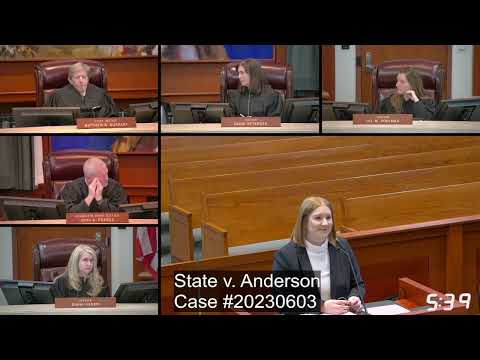
In State v. Anderson the state told the court 'district' should be read as a judicial district, pointing to territorial practice and the vicinage clause; the defense urged the court to read the statutory phrase in light of historical practice and legislative amendments as referring to county/prosecution districts. The court took the case under advisement.
During oral argument in State v. Anderson, counsel for the State and the defendant disputed whether the word “district” in Utah’s criminal venue statute refers to a judicial district or to a prosecution district.
Natalie Edmondson, arguing for the State, told the court the dispositive question is statutory meaning: "The court is tasked today with determining the meaning of the word district within the criminal venue statute" and argued "the only applicable and relevant district in that context is a judicial district" because prosecution districts did not exist when the venue statute was enacted in 1973. She relied on the vicinage-clause language and territorial usage to support her reading and said the statute’s language appears to have been transplanted from the vicinage clause.
Laurie Seppi, representing Mr. Anderson, asked the court to affirm the district court’s ruling that the word "district" means prosecution district (and, in practice, the county where the offense occurred). Seppi said the provisions that follow the initial venue subsection are written in county terms, the court’s past decisions have treated venue as county-based, and that canons of construction (including lenity and constitutional avoidance) support resolving ambiguity in favor of the defendant.
Justices pressed both sides on history and consequences. One justice asked whether the statute’s wording derives from the state constitution’s vicinage clause and whether the phrase was a "term of art." Edmondson responded that the venue statute incorporated a larger vicinage phrase and that vicinage and venue overlap because both depend on drawing a jury from the area where the offense occurred. Edmondson pointed to territorial-era statutes and the contemporaneous practice of referring to judicial districts in the territorial code.
The court also explored federal analogies and whether "district" could have been a placeholder for something the legislature might create later. Edmondson acknowledged that, theoretically, the legislature could create other units but maintained historical practice supports the judicial-district reading. Counsel and justices reviewed chronological touchpoints cited during argument: judicial districts and district attorneys in the late 19th century, district attorneys being repealed in 1971 with functions returning to county attorneys, the 1973 venue statute revision, the creation of prosecution districts in 1993, and the 1994 amendment that added "precinct" to the venue statute.
Seppi disputed the State’s construction on several grounds: the court has repeatedly discussed venue in county terms in prior opinions; the legislature amended the statute after prosecution districts were created without changing the court’s understanding; and multi-county prosecution districts (a statutory option) present hypothetical complications that the defense says counsel against an expansive reading.
Both sides acknowledged unresolved hypotheticals. Edmondson conceded a judicial-district reading could permit prosecutions anywhere within a judicial district under the venue statute but noted practical checks — consent or cross-deputization, electoral accountability of local attorneys, and potential separation-of-powers limits — could constrain opportunistic prosecutorial conduct. Seppi replied that permissive statutory language raising that possibility would likely generate future litigation and constitutional arguments if used against defendants.
Counsel exchanged citations and history on the record, including a published 1906 citation cited by the State (Sanapoli v. Pleasant Valley Coal Company, 86 P. 865 (Utah 1906)) and references to cases the parties said had earlier treated venue as county-based. At the conclusion of argument the court thanked counsel and said it would take the matter under advisement.
The court did not issue a ruling from the bench.