Get Full Government Meeting Transcripts, Videos, & Alerts Forever!
Get email alerts on the Civil Procedure topic
No spam. Unsubscribe anytime.
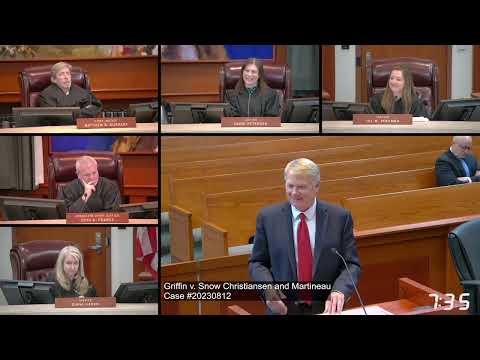
Utah Supreme Court hears arguments over Rule 4 definition of “managing agent” and service of process
Summary
In oral argument, counsel sharply disputed whether the Court of Appeals improperly broadened Rule 4 by adopting an 'integrated role' or actual-notice test for a managing agent; appellants urged change by rulemaking, respondents urged affirmance under Direct Mail and related precedent.
Rodney Parker, attorney for the appellant, told the Utah Supreme Court that the central question in the case is not merely definitional but procedural: whether a change in who qualifies as a 'managing or general agent' under Rule 4 should be made through formal amendment rather than by judicial decision. "To redefine that process now by judicial fiat ... should require an extraordinary reason," Parker said, arguing the rulemaking process provides notice, predictability and public input.
Ron Griffin, counsel for the respondent, asked the court to affirm the Court of Appeals. He urged that the Direct Mail line of cases supports treating a "managing agent" as an employee "so integrated in the corporation that he or she will know what to do with the papers," and said that titles alone are not controlling. Griffin argued that actual notice and the reasonableness standard from later cases (discussed in argument as Malane/Mullane-era law) are relevant factors in the fairness analysis for service.
Why it matters: the legal label used to validate service of process determines when a court has jurisdiction over a corporate defendant. If courts adopt the Court of Appeals' broader 'integrated role' or subjective actual-knowledge test, attorneys warned, that could inject uncertainty into longstanding service practices and invite litigation over whether recipients actually knew how to deliver papers.
Key arguments and record points: Parker emphasized that Rule 4's language has been in place for decades and that a district court finding showed Ms. Chapman lacked corporate-level managerial authority; he warned that relying on 'integrated role' risks converting the rule into a subjective knowledge test. Parker also pointed to a state service statute with parallel language (spoken in argument as "sixteen-seventeen-three 0 1") and raised a procedural objection tied to the saving statute: the trial dismissal was without prejudice; the case was refiled near the one-year mark and then dismissed again, and Parker argued the second dismissal ought to have been with prejudice under the saving statute's limits.
Griffin countered that Direct Mail and related precedent allow a facts-and-circumstances inquiry; he said actual notice to the corporation or evidence that a recipient was integrated in the firm's operations can mitigate due-process concerns. He cited the shift from the stricter Pennoyer-era requirements toward a reasonableness standard reflected in Mullane (discussed in the argument transcript as "Malane"). Griffin also acknowledged the Court of Appeals quoted evidentiary findings about Chapman's contacts with company leadership and committee participation.
What the justices focused on: bench questions probed whether the Court of Appeals had relied on dicta from Beard or Schwenke, whether paragraph 35 of the Court of Appeals opinion reflected district-court findings or an appellate synthesis of record evidence, and whether adopting the broader test would improperly encourage disputes about actual notice. A justice asked whether the phrase "authorization to implement the decisions" actually appeared in the district court's written findings; counsel debated whether that language reflected findings or was drawn from case citations.
Quotes from argument: Parker said, "It's the question, what is the definition of the phrase managing agent in Rule 4?" and later argued that "there's clear communication with the plaintiff how to bring a defendant before the court" under the existing rule. Griffin told the Court, "Titles are not controlling," and that a managing agent is someone "so integrated in the corporation that he or she will know what to do with the papers."
Procedural posture and next step: Counsel also debated collateral procedural points: whether dismissal-without-prejudice and the saving statute required a dismissal with prejudice after a timely refile. The Court thanked counsel and took the matter under advisement. No decision was issued from the bench.
Ending: The Court announced it would take the matter under advisement after hearing argument from both sides.