Get Full Government Meeting Transcripts, Videos, & Alerts Forever!
Get email alerts on the Itep topic
No spam. Unsubscribe anytime.
LED proposes streamlined ITEP application, single annual report; committee seeks local feedback
Summary
Louisiana Economic Development outlined proposals to shrink the Industrial Tax Exemption Program (ITEP) process from 15 steps to nine, combine advance notice and application into a single project application, and require one annual report (APPR) due March 31; committee members pressed LED on local notice timing and impacts to small parishes such as Cameron Parish.
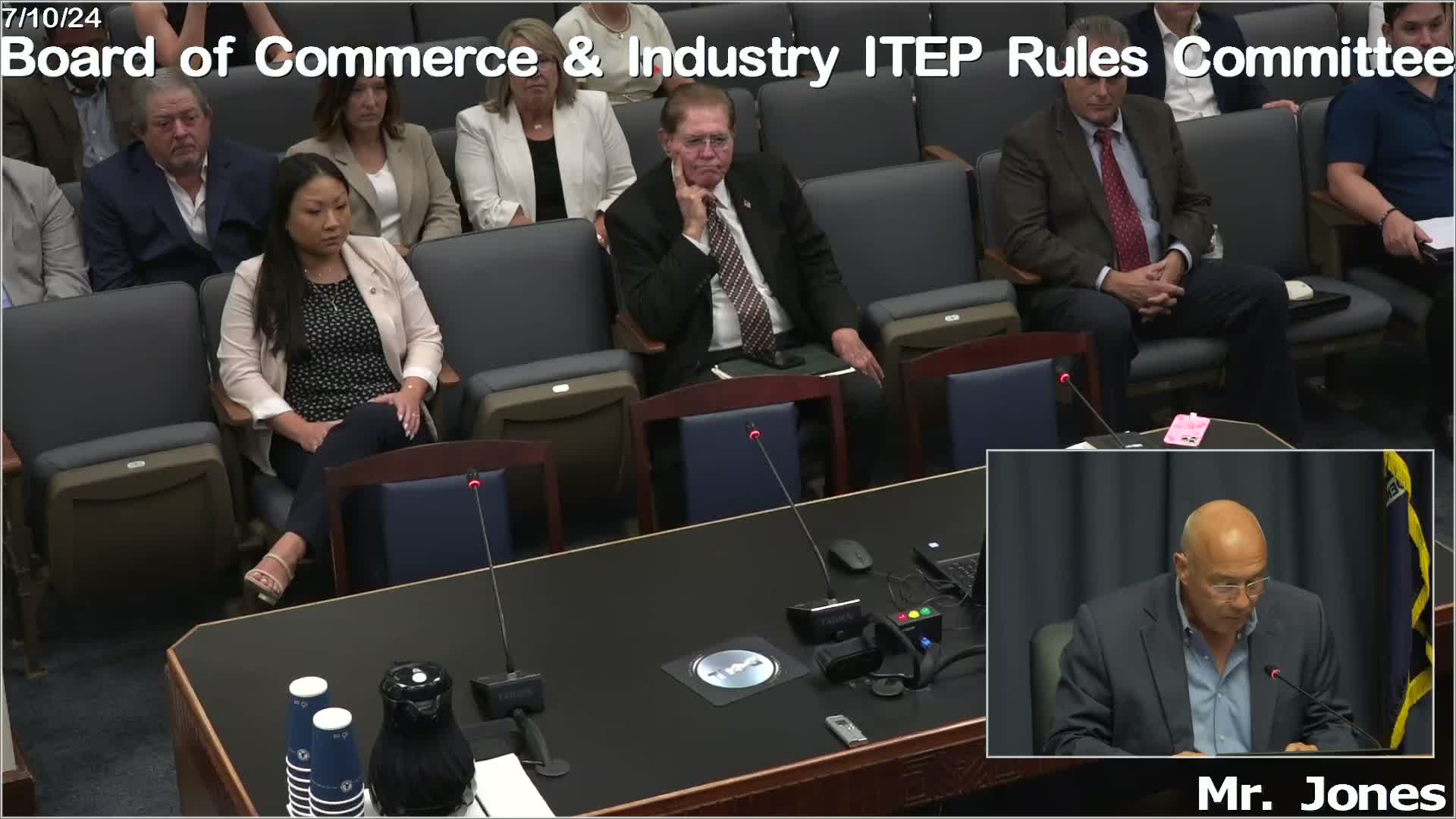
Louisiana Economic Development on Wednesday presented proposed rule changes to the Industrial Tax Exemption Program to the Board of Commerce and Industry Rules Subcommittee, saying the goal is to simplify a process industry and local officials have described as cumbersome.
Robin Porter, executive counsel for LED, told the committee the Constitution (Article VII, Section 21) gives the board authority over ad valorem tax exemptions and that LED intends to maintain core provisions — an 80% tax exemption for an initial five-year contract (with a five-year renewal option) and a 93% exemption for qualifying megaprojects — while reducing administrative burden. "We propose to reduce from a 15-step process to a 9-step process," Porter said, describing a hybrid "project application" that combines advance notice with the front-end application and consolidates multiple annual and phase filings into one Annual Project Property Report (APPR).
The APPR would be due March 31 each year and would replace phased applications, affidavits of final cost and other recurring forms; LED said the APPR is an attestation of property placed in service and will align filing deadlines with other taxing authorities. Porter said staff reviews would remain: LED review followed by reviews from the Department of Revenue and the workforce agency (LWC), and projects receiving no agency objections would move to the board for consideration.
Committee members pressed staff on local notice and how locals would be informed before the board places a project on its agenda. Chair (name not given in the transcript) said public access via LED's FastLane portal is not the same as proactive notice: "Most public officials are not sitting at their computer every day checking the LED website," he said. Kristen Johnson, program administrator at LED, said project fields will be visible in FastLane when filed and recommended programming a weekly opt-in report for local designees so officials receive manageable, timely notice rather than daily emails.
Several committee members asked how applicant estimates would be used. Porter said estimates are used to calculate application fees and to give locals a ballpark of project size; actual abatement is based on assessed value when property is placed into service. LED emphasized attestation by applicants to describe project scope and said staff will flag large deviations between estimates and later APPR filings for follow-up.
The meeting also focused on the local ITEP committee that the executive order contemplates. Porter described its membership as the parish president or police jury president, the school board president or superintendent (as selected by the school board), the sheriff or designee, and a municipal mayor if the project lies within a municipality; ex officio, nonvoting members could include the assessor and local economic development staff. LED proposed transmitting the application to local committee members within three business days, which would begin a 45-day notice period to conduct a local meeting; locals retain the option to take no action and thereby default to board approval.
Cameron Parish officials attending the meeting urged the state to consider ways to offset costs that accompany large projects. Tom Barrett, district attorney for Cameron Parish, said earlier notice would help the parish prepare for the service and infrastructure demands that follow large industrial builds. Scott LaVine, Cameron Parish assessor, told the committee that while some small taxable values come on during the abatement period, the parish has not yet seen a significant net increase in its tax base and that short-term burdens (school enrollment, additional public safety and sanitation costs) are real and acute in small parishes.
The chair asked stakeholders to submit focused comments and specific red-lines to LED within roughly a week and invited those willing to speak to the committee to appear at the next meeting, scheduled for August 12 in the morning. LED provided an email for comments: itepcomments@la.gov.
Formal committee actions at the meeting were limited to routine business: the subcommittee approved the minutes on a motion from Stuart Moss, seconded by Rodney Miller, and later adjourned on a motion from Rodney Miller, seconded by Mr. Polozola. The committee did not vote on ITEP rule changes and will return in August to hear additional stakeholder input.
What happens next: LED staff said it will continue preparing rule language and a redline for the committee, incorporate stakeholder feedback and return to the subcommittee on August 12. Stakeholders and local officials who want to be notified of filings were encouraged to use FastLane and to opt in to LED's proposed weekly notice list.