Get Full Government Meeting Transcripts, Videos, & Alerts Forever!
Get email alerts on the Housing Policy topic
No spam. Unsubscribe anytime.
Planning commission recommends inclusionary-housing amendment with AHAC corrections; urban-cluster expansion affordability lowered to 50% AMI
Summary
The commission recommended transmittal of Z24-00011, a county-initiated comprehensive-plan amendment to enable inclusionary housing incentives (substitution of nonresidential floor area for affordable units and bonus density) and to require affordable set-asides for certain future land-use changes; commissioners corrected AHAC's transposed AMI figures and voted to require 50% AMI for urban-cluster expansions.
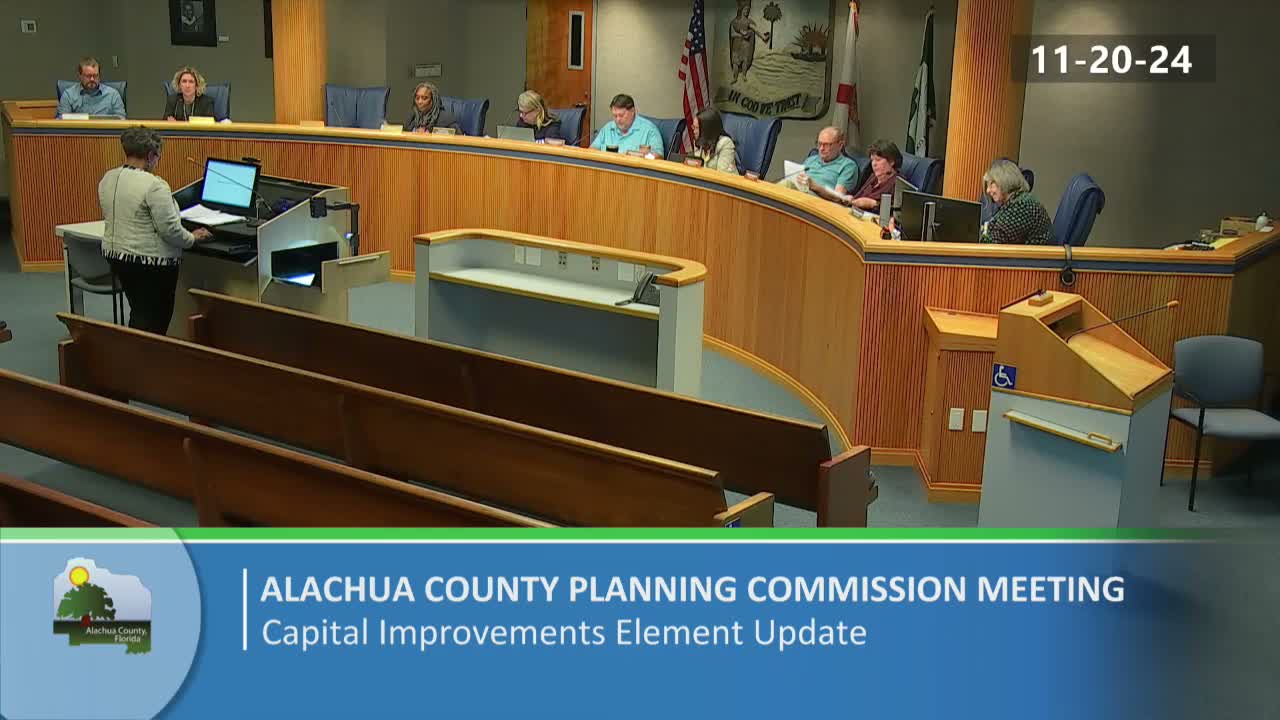
Alachua County staff presented Z24-00011 on Nov. 20, a proposed comprehensive-plan text amendment designed to make voluntary inclusionary-housing incentives (and limited mandatory triggers) more effective in producing affordable units in the unincorporated county.
Senior planner Ivy Bell said the changes would allow substitution of required nonresidential floor area in traditional neighborhood development (TND) and transit-oriented development (TOD) for affordable residential units, create a density-bonus option of up to four additional units per acre if at least 20% of the bonus units are affordable, and expand the set of incentives (including mobility-fee assistance and impact-fee adjustments). Staff proposed affordability thresholds up to 80% of area median income (AMI) for 30 years in the substitution/bouns programs; separate provisions would require a share of added units be affordable when a property seeks a future land-use change or urban-cluster expansion.
During public comment and AHAC (Affordable Housing Advisory Committee) discussion, speakers urged deeper affordability and larger set-asides. Staff acknowledged an error in the AHAC backup: the two AMI numbers intended by AHAC were transposed in the written materials. AHAC had recommended that TND/TOD substitution targets be at or below 80% AMI while urban-cluster expansions be targeted at 50% AMI. The commission voted to implement that correction and approved a motion recommending transmittal of Z24-00011 with the urban-cluster expansion AMI set at 50%.
Ivy Bell framed the policy tools as incentives rather than a strictly mandatory program: developers could opt to accept bonus density or the substitution (and thereby provide affordable units) or decline and keep the nonresidential requirement. AHAC member Bobby Mermer urged consideration of mandatory approaches for specific census tracts adjacent to the city and said AHAC had discussed a deeper affordability target for cluster expansions; other public commenters recommended set-asides as high as 20% and affordability down to 50% AMI for certain contexts.
Staff noted that the county's previous voluntary incentive program had produced no affordable units over the past two decades and that the proposed changes aim to create predictable mechanisms and enforceable land-use restriction agreements when units are required for longer affordability periods.
What's next: the planning commission recommended transmittal of the amendment to the state for review; the Board of County Commissioners will consider the proposal (and any revisions) before final adoption. If the board approves, implementing ordinances (impact-fee and mobility-fee changes and land-use restriction agreements) will be required to make the incentives operational.