Get Full Government Meeting Transcripts, Videos, & Alerts Forever!
Get email alerts on the Connectivity Code topic
No spam. Unsubscribe anytime.
Planning commission backs narrow code change to let reviewers block vehicular connections near loading docks
Summary
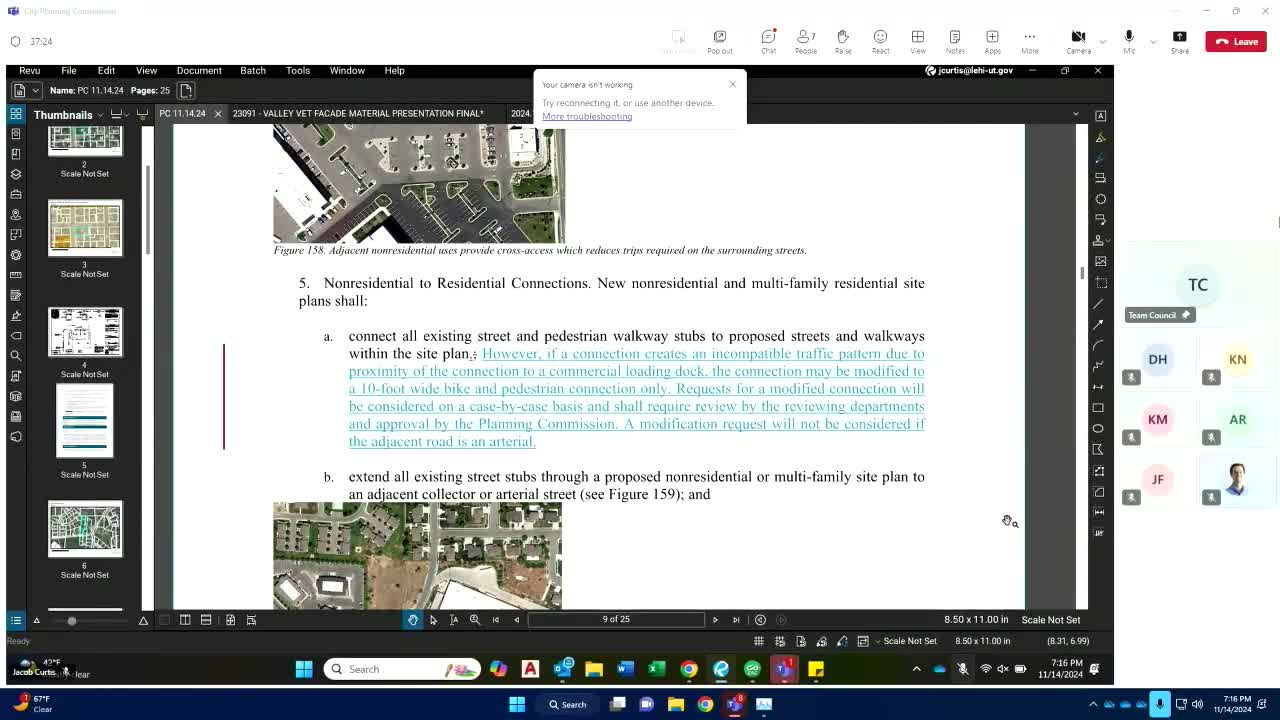
The commission recommended a narrowly written amendment to Chapter 37 that would let developers apply for a case‑by‑case exception to vehicular connectivity when a commercial loading dock would create an incompatible traffic pattern; bike and pedestrian connections would still be required. The recommendation moves to city council.
The Lehi City Planning Commission on Nov. 14 voted to forward a positive recommendation to the city council for a narrowly framed amendment to the city development code that would allow exceptions to vehicular connectivity where a commercial loading dock would create an incompatible traffic pattern.
Planning staff described the change as a limited, site‑specific mechanism that would permit applicants to ask the Development Review Committee and the commission to waive a vehicular connection while retaining required bicycle and pedestrian links. Rick Magnus of AWA Engineering, representing the applicant, said the proposed language responds to constraints on a specific grocery‑anchored site and warned that a tenant might decline the location without the flexibility. "We concur with staff recommendations on this," Magnus said, urging the commission to allow an exceptions process for cases where loading docks or grade make a standard connection unsafe or impractical.
Commissioners debated the scope of the rewrite. Several members said they prefer keeping the amendment narrowly tailored so it does not create a broad carve‑out; another commissioner urged staff to consider a future, broader overhaul of exceptions so other applicants could pursue adjustments where warranted. Staff and the applicant confirmed that, under current code, there is no formal way to request this particular exception without changing the ordinance; that is the primary purpose of the amendment.
The commission asked staff to remove a draft word (