Get Full Government Meeting Transcripts, Videos, & Alerts Forever!
Get email alerts on the Energy Microgrids topic
No spam. Unsubscribe anytime.
Puerto Rico lawmakers, mayors demand answers after $5M planning allocation for mountain microgrid stalled
Summary
Representatives and municipal leaders from five interior towns said a promised $5 million for design of a mountain microgrid (Consorcio Energético de la Montaña) announced June 3, 2021, has not been executed; they announced a hearing to summon PREPA officials and seek a timetable for transfer of assets and funds.
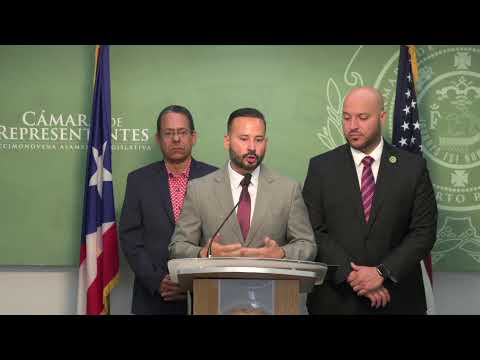
Representatives and municipal leaders from five central Puerto Rico municipalities urged immediate action on a long‑planned renewable microgrid during a press conference called by Representative Jesús Hernández Arroyo, chairing the House committee that handles energy issues.
Hernández Arroyo said the consortium — formed by Villalba, Orocovis, Morovis, Barranquitas and "Siales" — was promised a $5 million planning allocation on June 3, 2021, to design a microgrid that would provide resilience to mountain communities after Hurricane María. “El tres de junio del año veinte veintiuno, el gobernador de Puerto Rico, Pedro Pierluisi, informó la asignación de cinco millones de dólares para el diseño y creación de la micro red del consorcio energético de la montaña,” Hernández Arroyo said, adding that the funds have not been released and there has been no progress on project initiation.
Luis Javier Hernández Ortiz, mayor of Villalba and president of the consortium, described the technical and governance framework: the project would use the Toro hydroelectric plant and about 500 cuerdas of municipal land to build a solar farm with battery storage, and could produce roughly 140 megawatts at peak, with up to 30% reserve capacity to support the central grid. “El consorcio pudiera generar energía para darle estabilidad energética a estos cinco pueblos,” he said, and noted the consortium already has a feasibility study that received U.S. Department of Energy support.
Both leaders said negotiations to formalize an administration contract or asset transfer with the electric authority have stalled. They told reporters draft contracts were exchanged with the authority’s legal division but that talks were abruptly paused, blocking the consortium from meeting federal requirements needed to draw CDBG‑DR planning funds.
To compel answers, Hernández Arroyo announced the House committee will hold a public hearing next week and will summon the electric authority’s executive director — named in the transcript alternately as José and Josué Colón — and Francisco Berrío Pórtela, described as the assistant secretary for mountain energy affairs, to explain why the transfer has not been signed and to provide a timeline for release of funds and project next steps.
Speakers emphasized the consortium’s legal design: municipal legislatures approved a perpetual trust by unanimous vote, they said, and the vehicle is intended to be nonpartisan and stable across administrations. They argued the project could attract federal and private investment to cover early‑phase costs estimated in the tens of millions of dollars, with CDBG‑DR expected to guarantee 30–40% of initial financing.
Officials also flagged regulatory matters that remain in progress. Hernández Ortiz said the energy regulator is reviewing rules for wheeling (energy transfer and metering that would let mini‑grids sell locally), and described the project as phased: initial capital improvements and automation at the hydro plant, followed by construction of solar arrays and battery storage on the transferred land.
The press conference closed with the leaders reiterating their demand for accountability and an immediate, public explanation from the authority and the governor’s office about why the promised transfer and funds have not advanced. The committee’s hearing is scheduled for next week; organizers said the summoned officials will be asked to present the status of the draft contract, the steps needed to access federal planning funds, and firm dates for implementation.