Get Full Government Meeting Transcripts, Videos, & Alerts Forever!
Get email alerts on the Land Use Development topic
No spam. Unsubscribe anytime.
Grand Island conservation board advises against developing area of Ecologically Important District near Woods Creek
Summary
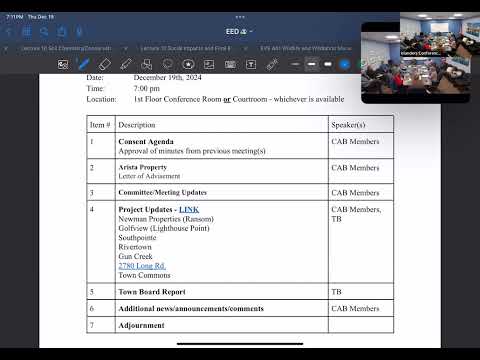
After a Dec. 7 site visit, the Grand Island Conservation Advisory Board voted Dec. 19 to draft a letter urging the Town Board not to develop portions of a proposed subdivision that intrude into an Ecologically Important District (EED) around Woods Creek, citing flood risk, steep slopes, multiple tributaries and large heritage oak-hickory trees.
The Grand Island Conservation Advisory Board voted Dec. 19 to draft a formal advisement to the Town Board recommending that parts of a proposed housing development that fall inside an Ecologically Important District (EED) along Woods Creek not be developed, citing flood-control risks and significant ecological values.
Board members said the recommendation followed a Dec. 7 site walk of two parcels — a 22.8-acre northern lot and a 12.9-acre southern lot — where members observed dense invasive buckthorn at the parcel edges but mature, old-growth oaks and a ravine channeling feeder streams into Woods Creek farther inland. The chair read the board’s summary of findings into the record and moved that the board "draft a letter of advisement that ... the part of the development that intrudes into the EED not be developed" because of flood-control concerns, steep elevation changes, adjoining tributaries and large trees stabilizing stream banks; the motion carried on a voice vote.
Why it matters: Board members argued that the site’s roughly 20-foot elevation drop over a short horizontal distance concentrates runoff into Woods Creek and increases the risk that development—with added impervious surfaces and driveways—would deliver sediment and urban runoff into the creek, worsening flooding downstream at the Town Commons and adjacent businesses. Members also highlighted the presence of older oak-hickory trees they described as "heritage" trees that help hold stream banks in place and support local biodiversity.
Disputed ecological assessment: The board discussed a March developer-supplied assessment prepared by a private consultant (discussed in the meeting as Earth Dimensions). Several members said the consultant’s photos and summary did not reflect what the board saw on the ground — in particular, large trees and steeper slopes — and the board plans to attach its own photographs from the Dec. 7 walk when it submits the letter. One board member noted the consultant’s report presented saplings in photos where the board observed much larger trunks and a thicker understory.
Policy context and next steps: The board noted that the parcels are covered by the town’s EED overlay and flagged apparent nonconformance with the Local Waterfront Revitalization Program (LWRP) provisions cited in the review discussion. The northern parcel appears in the Western New York Land Conservancy’s Open Space Index as a high-priority parcel (ranked 36 of 155); the southern parcel was also ranked high (around 50 of 155). The board said it will include parcel identifiers and its photographs with the advisement and forward that package to the Town Board for consideration; the motion to draft the letter passed and the chair said the board will send the advisement when finalized.
Representative quotes from the meeting included the chair reading the recommendation: "After walking the properties on December 7, 2024, the CAB recommends that the part of the development that intrudes into the EED not be developed," and a board member describing the trees observed on site: "I think the ones that we were among must be 1 to 200 years old." The record does not show a recorded roll-call vote count or the name of the seconder for the draft-advisement motion.
The board’s advisement is advisory only; the Town Board retains final authority over zoning and development approvals. The Conservation Advisory Board said it will continue to review future submittals and expects to comment again if the developer revises the plan to move structures out of the EED or to provide more detailed mitigation design.