Get Full Government Meeting Transcripts, Videos, & Alerts Forever!
Get email alerts on the Housing Affordable Bonds topic
No spam. Unsubscribe anytime.
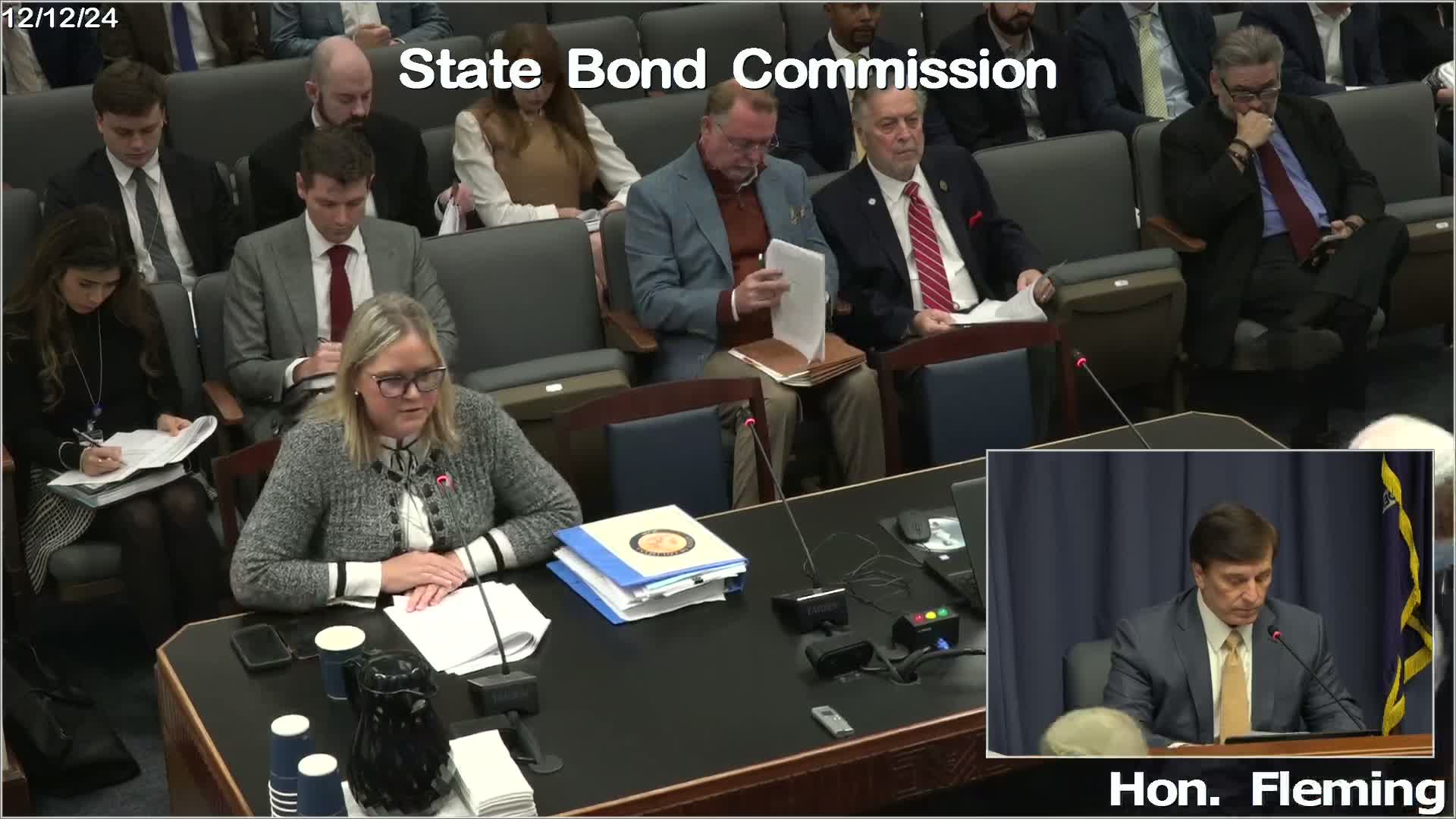
Bond commission approves 16 affordable housing bond projects amid renewed scrutiny of costs and QAP revisions
Summary
The commission approved 16 multifamily housing revenue bond items (52–67) and heard debate about rising per-square-foot costs and the need to strengthen the Qualified Allocation Plan (QAP). Staff and Louisiana Housing Corporation officials said cost-containment measures and QAP updates are underway.
The State Bond Commission approved a slate of multifamily housing revenue bond requests (items 52–67) at its Dec. 12 meeting after staff presented technical reviews and cost analyses for each project.
Staff said the projects include a mix of rehabilitation and new construction across the state — from conversion of historic office buildings into affordable units in Baton Rouge to senior-housing redevelopments and multi-story mixed-income developments in New Orleans. For each application, staff said the projects meet technical requirements and provided an accompanying cost-analysis packet that separates hard construction costs from soft costs and other development expenses.
Why it matters
Commissioners said they are increasingly focused on cost containment for projects financed with tax-exempt bonds and low-income housing tax credits, citing examples where total development costs (TDC) and per-square-foot numbers have risen materially. The commission and staff flagged the need to reconcile hard-cost per-square-foot figures with total project costs so decision-makers and the public have a clearer picture of overall spending.
What officials said
Wayne Neveu, a special housing consultant to Louisiana Housing Corporation (LHC), explained that tax-credit projects must conform to the QAP, rely on independent market analyses to justify location and feasibility, and depend on local zoning and environmental clearances. "Developers seek out the most cost-effective location, based upon demand study," Neveu said.
Steven Dwyer, chairman of LHC, said the corporation has been working with the Treasurer’s Office and Bond Commission to implement cost-containment measures reflected in a forthcoming QAP revision. "We are absolutely dedicated to our cost-containment measures, and we have been working hard over the last several months to satisfy those concerns," Dwyer said.
Commission concern about volume cap and costs
Commissioners asked whether approving all 16 projects would exhaust the state’s volume cap; staff reported an available ceiling and pending calculations but said additional cap will become available next year based on federal calculations. Representative Bakula and other members repeatedly urged clearer cost breakdowns and suggested updating rules going forward so that future projects adhere to newly adopted cost-control standards.
Project examples
- Item 52 (263 Third project, Baton Rouge): redevelopment into 67 affordable units; staff listed TDC about $31.4 million with hard construction and soft-cost breakdowns in the packet. - Item 61 (NSA East Bank Apartments, New Orleans): redevelopment of a vacant U.S. Marine headquarters into 294 units, retail space and a 784-space covered parking garage; TDC reported at about $166 million.
The vote and next steps
Commissioners approved items 52–67 collectively after staff presentation. Staff signaled the QAP may be adopted in early January and that the commission will be more closely involved in cost reviews going forward. LHC officials and the commission said they expect to implement new cost-control mechanisms in upcoming applications and to continue detailed packet-level analysis of hard and soft costs.