Get Full Government Meeting Transcripts, Videos, & Alerts Forever!
Get email alerts on the Nullification topic
No spam. Unsubscribe anytime.
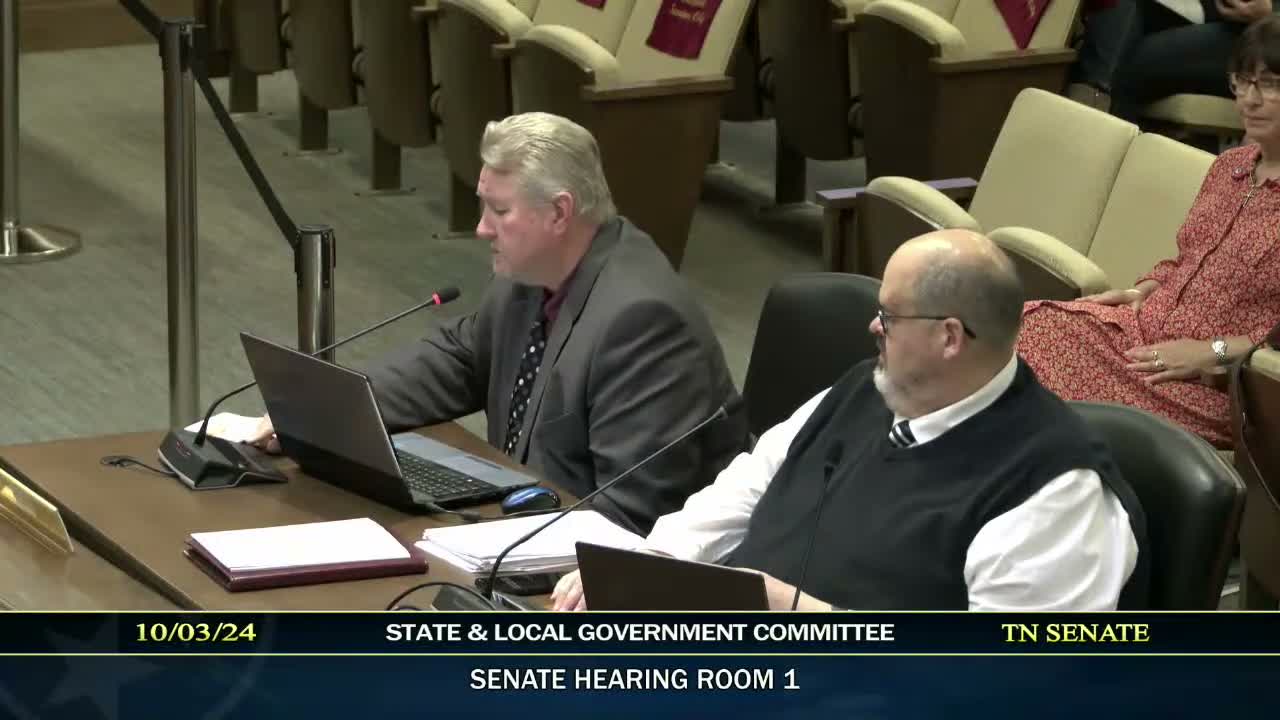
Tennessee Senate panel hears sharply divided legal arguments on proposed 'nullification' process bill
Summary
A Tennessee Senate summer-study hearing drew competing constitutional testimony about SB 2775/SB 1092: outside scholars urged codifying a state nullification process to resist perceived federal overreach, while other lawyers warned the approach is constitutionally unsound and could create legal chaos. Committee members probed practical consequences, including federal funding and disaster response; no vote was taken.
A Tennessee Senate committee convened a summer-study hearing to examine the legal theory and draft mechanics behind proposals labeled in testimony as SB 2775 and SB 1092, drawing sharply divided testimony from outside constitutional scholars and lawyers.
The committee’s chair opened the session by saying the meeting was informational and that "we're not gonna be voting on anything," then introduced two witnesses who presented opposing views. Jeff Cobble, an attorney who described himself as a constitutional scholar, argued for a textualist reading of the U.S. Constitution and said powers not delegated to Congress remain with the states and the people. "When statutory language is clear … we must apply its plain meaning," Cobble told senators, framing nullification as a lawful remedy when federal action exceeds Article I, Section 8 authorities.
Joe Wolverton, a second proponent, urged the panel to adopt a statutory process that would allow states and localities to challenge and refuse to enforce federal actions they deem unconstitutional. Wolverton described several initiation routes the proposed legislation would create — including action by the legislature, the governor, a court order, a petition by "2,000 registered voters," or action by "10 communities" — and repeatedly rejected the attorney general’s earlier opinion as "constitutionally infirm." He invoked historical examples, including the Kentucky and Virginia resolutions and state resistance to the Fugitive Slave Act, to argue that states have precedents for resisting federal measures they consider unlawful.
Opposing testimony came from Mark Pulliam, a lawyer and writer, who said nullification is a "fringe" legal theory that the U.S. Supreme Court and 200-plus years of precedent have repeatedly rejected. Pulliam cited Cooper v. Aaron and warned the committee that SB 2775, if enacted, "would surely be struck down as unconstitutional and ... reflect poorly on the Tennessee General Assembly." He also warned of practical consequences: allowing executive orders or individual judges to nullify federal law could produce inconsistent results across courts and invite legal chaos.
Committee members focused their questions on two linked issues: legal authority and practical consequences. Several senators asked which institution the founders intended to be "the final arbiter" of constitutional meaning; Wolverton and cobble pointed to state and popular remedies, while Pulliam reiterated the role of federal courts, Marbury v. Madison, and established precedent. Senators also asked whether nullification would undercut federal disaster relief and other funding streams. Wolverton and Cobble said states and private actors historically addressed disasters without federal programs and described some federal programs as beyond constitutional bounds; Pulliam responded that refusing federal funds would impose concrete tradeoffs for schools, roads and FEMA-supported recovery.
Sponsor-related points and procedural notes were raised but no formal action was taken. Senator Bolling — present earlier by phone and cited by the chair as a sponsor of related bills — read a 2021 resolution recognizing the General Assembly’s authority to respond to certain federal actions and described the bill as providing orderly routes for the state or localities to initiate review. The chair closed the hearing without a committee vote and left any statutory decisions to a later stage.
What it means: The hearing underscored a deep divide within legal conservative circles over nullification. Supporters framed SB 2775/SB 1092 as a clarifying, educative statute that would give counties, voters, judges, governors and legislatures a defined process to assert state authority; opponents said the doctrine is contrary to settled Supreme Court doctrine and warned it risks legal instability and the loss of federal resources if the state refuses federally conditioned funds.
The committee did not take a vote. Staff distributed copies of a Tennessee attorney general opinion to members and the hearing record will be available on the legislature’s webcast archives; further committee action or bill referral was not announced during the session.