Get Full Government Meeting Transcripts, Videos, & Alerts Forever!
Get email alerts on the Land Use Development topic
No spam. Unsubscribe anytime.
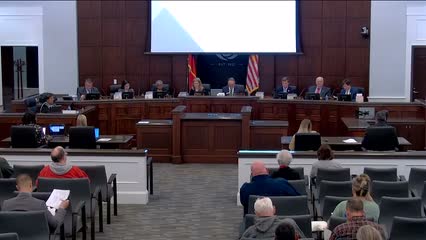
Gainesville approves annexation and PUD rezoning for 141‑unit development on Thompson Bridge/Crystal Drive
Summary
After a public hearing with neighborhood opposition, the Gainesville mayor and council unanimously approved annexation and rezoning to a planned unit development for a 141‑unit project that includes 53 detached homes and 88 townhomes, subject to 17 conditions including buffer and architectural standards.
Gainesville’s mayor and council on Tuesday unanimously approved the annexation and planned unit development (PUD) rezoning for a 36.38‑acre proposal by Grama Communities that will create 141 for‑sale residential units along Thompson Bridge Road and Crystal Drive.
Planning staff described the project as 53 single‑family detached homes and 88 townhomes, with an access road from Thompson Bridge Road, a gated emergency access to Crystal Drive, and onsite amenities such as a clubhouse, pool, playground and trails. Planning staff recommended conditional approval with 17 conditions that include architectural quality standards, perimeter buffers (50 feet along Thompson Bridge Road and 40 feet along other perimeters after graded/replanted buffer), a mandatory homeowners association, and a covenant limiting rentals to no more than 20% of the total units.
“Construction will occur over a period of 48 months,” Ethan Underwood, the applicant’s attorney, told the council, describing a one‑year site development period followed by roughly three years of home construction. Underwood said townhomes would range roughly 1,550–1,850 square feet and detached homes from about 1,200 to 3,100 square feet; he estimated townhome starting prices in the mid‑$300,000s and detached homes starting in the high‑$300,000s to the $400,000s.
Neighbors who spoke urged denial or changes. Nicholas Shardell, who lives on Oakland Drive near the site, said, “I’m asking you not to approve the rezoning to PUD. This is a very large density plan. It’s completely out of character and incongruous with the neighboring communities,” and raised concerns about increased traffic on Thompson Bridge Road. Scottie Ball, speaking as a resident, said he supported the concept but urged lower density and changes to unit design, arguing single‑garage townhomes could lead to on‑street parking and slow sales: “I am not opposed to this in total. I like the concept. I would just like to see it dialed back a little bit.”
Planning staff and the applicant cited several mitigations. The applicant revised the site plan to relocate the Thompson Bridge Road access farther north and more centered on the property after staff and neighbor comments; staff said the traffic study used growth rates recommended by GDOT and that the project did not trigger a traffic signal warrant. The developer presented results from a Phase I archaeological survey and a subsequent field survey that found no records of burial sites or pre‑contact Native American resources, noting only early‑ to mid‑20th‑century farmstead features.
Council considered three separate formal actions tied to the project: annexation ordinance 2024‑33, zoning ordinance 2024‑34 (PUD) with the 17 conditions, and rezoning ordinance 2024‑35. Each motion was seconded and each ordinance passed unanimously.
The council’s approval imposes the recommended conditions and the rental cap covenant; specifics of final engineering, permitting, utility relocations, and any required GDOT approvals for access will be resolved during the permitting process. The applicant indicated construction sequencing and pricing estimates but did not provide firm sales timelines beyond the multi‑year construction window.