Get Full Government Meeting Transcripts, Videos, & Alerts Forever!
Get email alerts on the Utility Rates topic
No spam. Unsubscribe anytime.
Guam PUC approves initial rate‑stabilization funding after debate over credit‑card fees
Summary
The Guam Public Utilities Commission approved an initial replenishment for the Guam Water Authority’s rate stabilization fund starting FY2026, after hearing competing recommendations over whether credit‑card transaction fees should be charged to card users or absorbed by all ratepayers. Commissioners voted unanimously to approve the RSF funding level and left credit‑card charges within GWA’s revenue requirements.
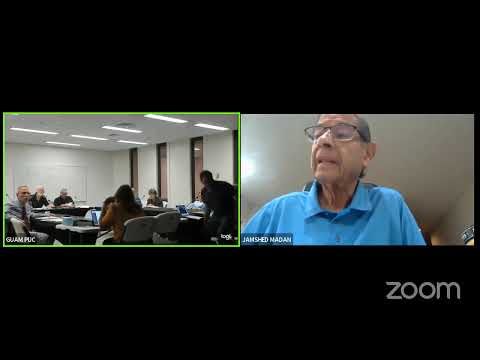
The Guam Public Utilities Commission on a special session approved an initial replenishment of the Guam Water Authority’s (GWA) Rate Stabilization Fund (RSF) beginning in fiscal year 2026 and left credit‑card transaction fees as part of GWA’s overall revenue requirements rather than imposing a separate convenience fee for card users.
Commissioners voted to adopt a motion setting an initial RSF replenishment amount (the motion was moved by Doris and seconded by Rovina), and the chair announced, “Motion carries unanimously.” The order read into the record specified an annual RSF replenishment of $1,250,000 beginning FY2026; final five‑year rate figures will be determined and incorporated into the written order after staff completes the numeric calculations and any errata are applied to the signed stipulation.
The decision came after competing presentations from Georgetown Consulting Group (GCG) and GWA staff over two unresolved items in a broader joint stipulation: (1) whether customers who pay by credit card should be charged a convenience fee to cover merchant charges and (2) whether and how to prefund the RSF across FY2026–2029.
GCG’s presenter Jim Madden told commissioners that credit‑card transaction fees cost GWA roughly $1.5 million a year — about $7.5 million over the five‑year plan — and argued those costs are caused by card users and therefore should be borne by those customers via a convenience fee of roughly 1.5%. "The staff recommendation in conclusion is as follows. GWA should implement the 1.5% fee on those customers that use their credit cards to pay their bill," Madden said, noting GWA had not presented data proving customers would stop using cards if charged.
GWA representatives countered that accepting card payments is a standard cost of doing business, supports customer convenience (and contactless payments adopted during the pandemic) and that implementing a per‑user fee would require operational and app modifications. A GWA speaker argued the RSF plays a distinct, debt‑service‑coverage role and said the utility favored a one‑time 1.5% increase in FY2026 to begin replenishing the RSF. "GWA's position on the rate stabilization fund is that we support ... replenishing the rate stabilization fund through a one‑time increase of 1.5% in fiscal year 26," the GWA representative said.
Georgetown’s staff presentation urged caution about prefunding a $10 million RSF immediately given the commission's finding that rate increases in the plan would already produce what staff called a rate‑shock environment; staff noted GWA’s substantial cash balances (presented as roughly $298 million in restricted and unrestricted cash) and recommended conditions before larger replenishment. GCG recommended the costs caused by card users be recovered from those users so non‑users would not fund the convenience cost.
Commissioners examined multiple scenarios — including alternatives that would pair some RSF funding with either retaining or applying a credit‑card convenience fee — and discussed staged or smaller starts to replenishment. After clarifying numeric alternatives on the record, the commission approved the motion to start RSF replenishment at the stated dollar level and confirmed the stipulation’s other provisions (including regulatory assets and reporting requirements) while acknowledging staff would correct a spreadsheet error in the signed stipulation via errata.
The final order, as read, keeps credit‑card company charges included in GWA’s projected administrative and operating expenses (i.e., funded through GWA’s revenue requirement) and sets the RSF replenishment schedule beginning FY2026 as recorded; the commission noted final rate tables will be updated and published after numeric corrections and completion of the order drafting.
Next steps: staff will finalize the rate calculations and incorporate the agreed errata; the commission’s written order will specify the final five‑year rate impacts and any reporting deadlines (the stipulation requires GWA to report on specified water‑loss control projects and, separately, on segregation options for Navy water purchases).