Get Full Government Meeting Transcripts, Videos, & Alerts Forever!
Get email alerts on the Session Law 2025 97 topic
No spam. Unsubscribe anytime.
NCPRO explains how session law 2025-97 allows limited general‑fund swap for unspent SFRF revenue‑replacement projects
Summary
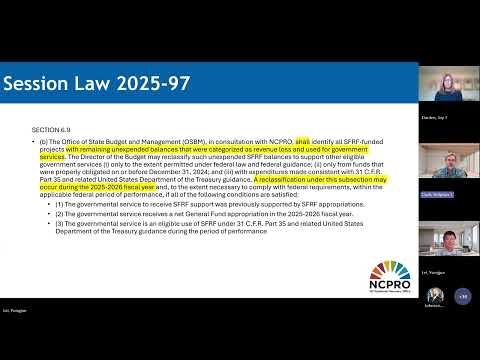
Tommy Clark, director of the North Carolina Pandemic Recovery Office, described how Session Law 2025‑97 and section 6.9 permit a one‑for‑one replacement of unspent State Fiscal Recovery Fund (SFRF) dollars in revenue‑replacement projects with nonrecurring general‑fund dollars, and outlined reporting and timing requirements for agencies. (Short: 335 characters)
Tommy Clark, director of the North Carolina Pandemic Recovery Office (NCPRO), told state grant managers that Session Law 2025‑97 gives state officials limited flexibility to replace unspent State Fiscal Recovery Fund (SFRF) dollars in revenue‑replacement projects with nonrecurring general‑fund dollars.
Clark said the law requires NCPRO to report to the General Assembly “all of the unexpended balances” in SFRF revenue‑replacement projects and that a reclassification — closing an SFRF project and substituting general‑fund revenue dollar for dollar — is a possible outcome in projects that cannot be liquidated on time. He added the swap is intended only to finish existing project intent and “is not gonna be free general fund money.”
Under the mechanics Clark described, projects identified with unspent SFRF would be closed, SFRF balances removed, and nonrecurring general‑fund dollars would be appropriated to the same project intent. Clark emphasized agencies should prefer to spend SFRF funds out before pursuing a swap; if a project can reasonably be spent by Dec. 31, 2026, NCPRO prefers agencies finish it with SFRF to avoid extra paperwork for agencies, NCPRO and the Office of State Budget and Management (OSBM).
Clark said subsection 6.9(e) requires NCPRO to submit a report to the General Assembly no later than April 15 identifying unexpended SFRF balances as of Dec. 31, 2025. He also noted subsection C provides a small accounting tolerance (a ‘‘$10 cushion’’) to correct minor reclassification rounding errors.
The reporting requirement can also identify projects that are complete with excess SFRF funds and projects that need additional funds; Clark said identifying projects is the first step toward any request for additional funding but that the General Assembly must act to authorize increases.
Next steps: NCPRO grant managers will confirm project status through December 2025, and agencies should submit December expenditure reports in January so NCPRO can compile the April submission to the legislature.
Clark closed the segment by urging agencies to raise scenarios and questions at future monthly meetings so the office can prepare accurate reclassification recommendations and legislative reporting.