Multnomah County unveils countywide strategic plan, will pilot implementation with FY27 budget
Summary
County staff presented a finalized FY26–FY28 strategic plan, citing broad community support from a 463‑response survey, and said FY27 will be used as a pilot year to align department program offers, build a dashboard and collect baseline measures ahead of full implementation.
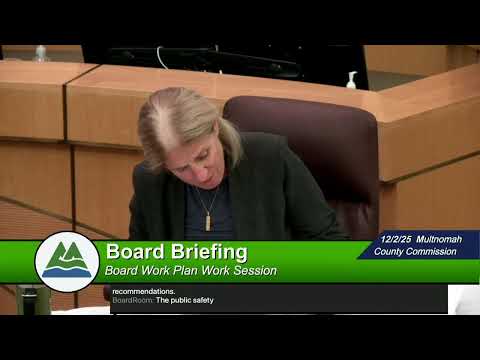
Multnomah County staff on Tuesday presented a finalized countywide strategic plan they said will guide the next three years of departmental work and budgeting. Christopher Neil, the county’s chief operating officer, said the plan—posted on the county’s website—translates board policy priorities into measurable outcomes, indicators and department-level measures.
"We actually just put the full plan up on our public website," Neil told the Board. He said the plan is the product of over 140 staff contributors, multiple leadership work groups and community engagement.
Samuel Ashby, the county’s director of strategic initiatives, described the plan’s structure: five focus areas with outcomes, indicators and measures that will be disaggregated by relevant demographics when available. Staff emphasized a three‑tier data structure—measures flow to indicators, indicators to outcomes—to help the county track progress and adjust strategies.
Lisonbee Sachet of the Evaluation and Research Unit said a community pulse survey drew 463 responses and showed broad public support: "more than 80% of community respondents indicating that they like or love the outcomes," with several outcomes rated at about 90% support. Staff said there are 34 indicators in the plan and that measures will include percentages, rates and disaggregated counts.
Because of federal and state budget uncertainty, staff proposed using the FY27 budget cycle as a pilot year: departments will attach program offers to strategic measures, the Spark team will release a first dashboard by Feb. 1 populated with FY26 program information, update it after departmental budget submissions on March 1 and mark up the dashboard to reflect the chair’s proposed budget on April 16. An updated board-facing dashboard was scheduled to be available by May 1, with final alignment after budget adoption in early June.
Presenters stressed implementation steps including reconvening leadership and data workgroups, analyzing data infrastructure, identifying data stewards, and building a practical operating system to link strategy and budgeting.
Commissioners applauded the plan’s research and collaborative process but pressed staff on specifics—how the county will reduce disparities, how measures will be disaggregated, and how departments that have not historically tracked particular data will be supported. Commissioner Singleton said an indicator addressing homelessness should explicitly name disparity‑reduction goals, and urged inclusion of the county sheriff’s pretrial services in supervision and compliance measures because it serves hundreds of residents.
Staff acknowledged data gaps and said one goal of the pilot year is to surface which departments collect which data and to identify resource needs for consistent collection and reporting. Neil and other staff said building the data platforms and processes will require budget investments and iterative adjustments.
The board did not adopt the plan as a vote at the briefing; staff described next steps for baseline data collection and the budget alignment described above.
AI generated
The text on this page is AI generated. Summaries, highlights, analysis, and video transcripts are all produced from the original source material.
AI can make mistakes, so if you spot one, and we will fix it for everyone.
Note: the source content is unaltered by us. Any content source we link to, be it a video, an audio recording, or a document, is presented exactly as its publisher released it. That publisher is usually a government body, sometimes an individual official or another organisation.