
Sheboygan council adopts ordinance enabling special charges and loan security for lead service line replacements
Get AI-powered insights, summaries, and transcripts
Subscribe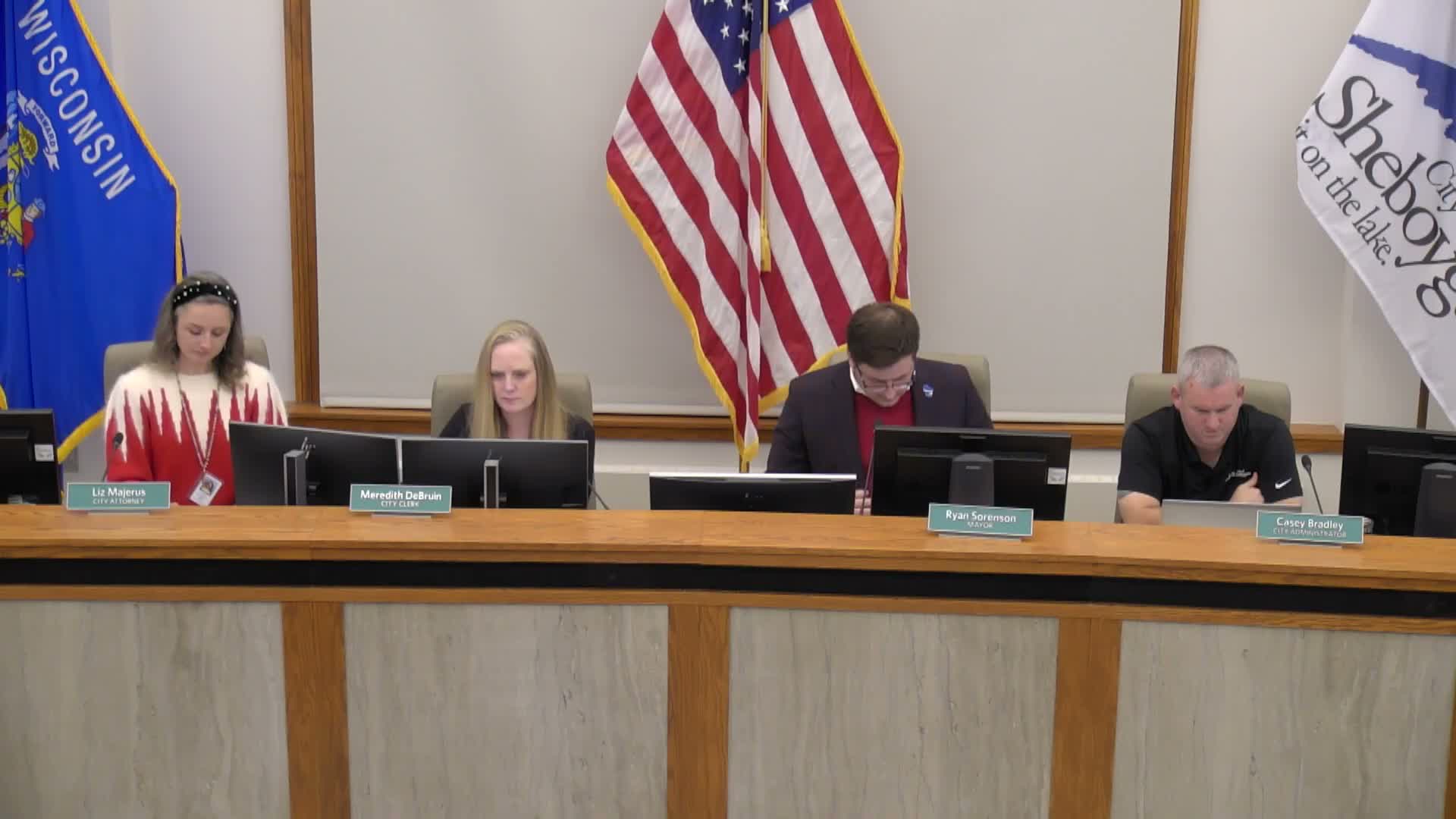
Summary
Council adopted an ordinance allowing special charges for service lateral replacement and the use of those charges as security for Safe Drinking Water loan programs; councilors sought clarification on eligibility, funding sources and capacity to replace roughly 5,500 suspect lines.
The Sheboygan Common Council adopted an ordinance amending the municipal code to permit special charges for service lateral replacement and to allow those special-charge revenues to secure Safe Drinking Water loan program financing.
Alder Boris and others questioned specifics of eligibility and how much assistance property owners could expect. Attorney Majeris and City Administrator explained that program terms—whether forgivable grants, low-interest or no-interest loans—depend on the state and federal funding parameters that back each program. “If the state or the federal government sets parameters on income limits or anything like that, then that would carry forward into the grant application that the city uses,” Attorney Majeris said.
Council members discussed program scale and cost. City staff said roughly 5,500 service lines in the city are suspected of needing replacement, and the utility currently has capacity to replace about 300 lines per year. The city engineer noted that doing replacements in bulk with a single contractor reduces per-line costs; staff estimated that program costs can be close to $7,000 per line under bundled contracts but can exceed $10,000 for individual standalone replacements.
City Administrator clarified that the ordinance authorizes the city to accept and implement loan or grant programs if the funds become available; authorizing the ordinance does not by itself commit city dollars. “This is authorizing application so this is through Federal Highway… Should we get it then that will come back with a grant agreement and we'll have terms to the grant at that point,” the City Administrator said (regarding a separate grant discussion earlier in the meeting).
The ordinance was adopted by roll call. The council heard no formal amendments to the ordinance during the meeting. Staff said eligibility criteria and exact assistance levels will be set by the funding program when an application is accepted and terms are known.
Next steps: staff will proceed with program implementation consistent with available funding and program rules; property owners are encouraged to consult the water utility’s map showing suspected lead or galvanized service lines.