
Petitioners present written commitments and technical data as council hears a lengthy public hearing on proposed West Saint Joseph County data center
Get AI-powered insights, summaries, and transcripts
Subscribe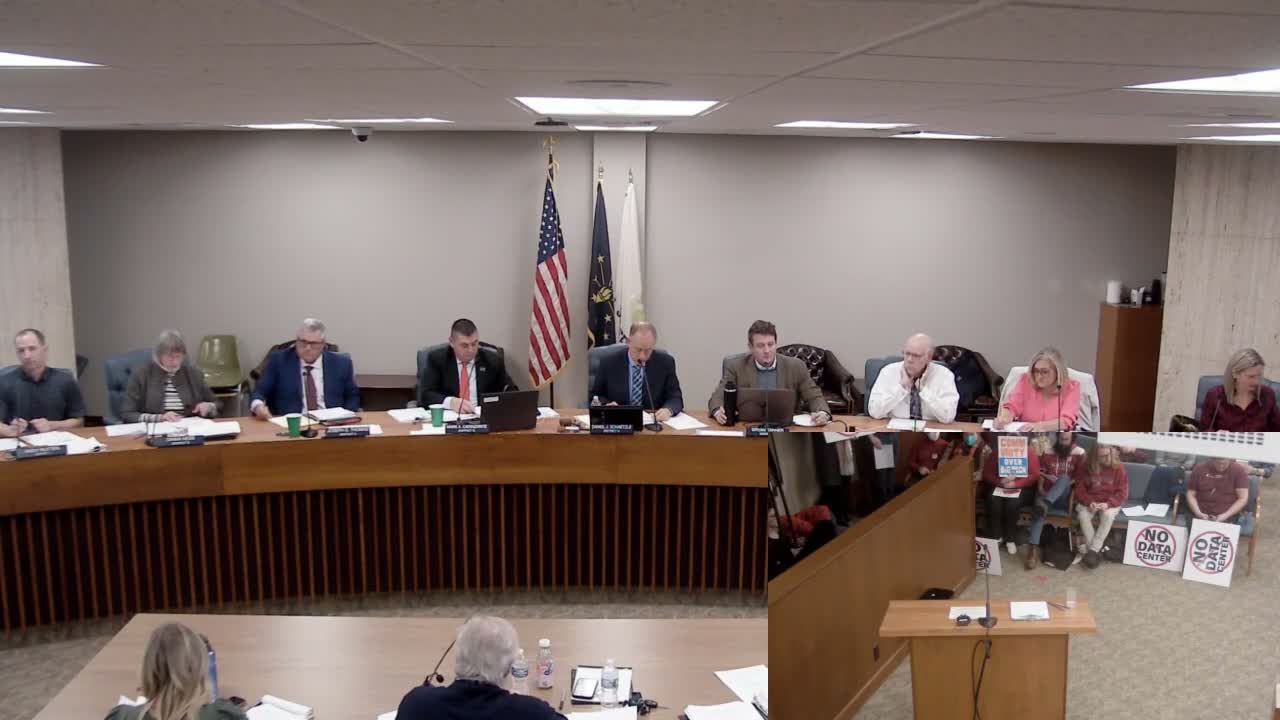
Summary
Petitioners seeking to rezone about 1,000 acres for a 14-building data center campus presented 12 written commitments and technical clarifications on water, power and environmental controls; the council held an extended public hearing and did not vote Thursday.
Saint Joseph County Council heard an extended public hearing and technical presentation on Bill 42-25, a petition to rezone roughly 1,000 acres on the south side of Chicago Trail from agricultural to industrial to allow a multi-phase data center campus.
Sean Klein, director of the Area Plan Commission, opened the item by reporting that the petition carried an unfavorable APC recommendation (7–0) and that the land-use committee forwarded it with an unfavorable recommendation (3–2). Klein summarized the public record: petitioners provided several letters in favor while the APC hearing recorded many written remonstrances and spoken opposition.
Brandon Dickinson, representing the petitioner, told the council the project has been the subject of misinformation and pledged transparency. He read a series of points denying that staff or council were under nondisclosure agreements and emphasized the site lies in unincorporated Saint Joseph County — not within New Carlisle — which is why the county has zoning jurisdiction. Dickinson also said the project would not "take" New Carlisle's water but would coordinate service with the town's regulated utility.
Dickinson and engineer Annie Denine (Kimley-Horn) presented a draft set of 12 written commitments the petitioner said it would accept if the rezoning passed. Those commitments include prohibiting several heavy industrial uses, a minimum 450-foot building setback from adjacent properties and public rights-of-way, a maximum building height of 75 feet, a cap of 14 data-center buildings in total (additional buildings to require council approval), an hourly noise limit of 60 dB at contiguous properties, restrictions on generator testing hours (12 p.m.–4 p.m. weekdays), drainage approval by the county engineer, required landscaping and berms, a minimum 150-foot setback for security fencing from Chicago Trail, and post-construction emergency responder drills.
Annie Denine and "Andy," civil/consulting engineers for the project, addressed water and sanitary demands. Denine explained that domestic wastewater demand per building would be modest (roughly 750–1,250 gallons per day per building, equivalent to a small hotel) and that the significant flows would occur only under water-cooled chiller peak events. She described a closed-loop cooling preference that can be air-cooled (zero ongoing external water use after initial fill) or water-cooled (higher peak water use). Andy estimated peak cooling-related water use in the "low six-figure" thousands-of-gallons range per peak event and said on-site storage could mitigate peak draws; he added that much of the year ambient conditions reduce cooling water demand.
Council members pressed the petitioners on details: water sources and whether the New Carlisle utility could serve peak cooling; whether closed-loop systems or air-cooled chillers would be used; the potential for chemicals in closed-loop systems and how drained loops would be treated and sent to South Bend sanitary treatment; the scale and siting of buildings; limits on future expansion; and construction lighting mitigation. Dickinson and engineering staff repeatedly said designs were not final and said many items (utility extensions, developer agreements, and potential economic development agreements) would be negotiated later. Dickinson repeatedly emphasized the written commitments were designed to address neighbor concerns.
Petitioners also cited an Indiana Utility Regulatory Commission (IURC) tariff negotiated with Indiana Michigan Power and consumer advocates that they said prevents costs associated with large data-center loads from being shifted to smaller customers (they described minimum-billing/contract obligations and collateral/credit requirements for large loads). Dickinson said the IURC order and tariff limit risk that a data center would cause higher residential rates.
County representatives and external witnesses addressed public finance implications. Michael Castellon, Saint Joseph County assessor, described the budgetary context: changes under recent state law (Senate Enrolled Act 1) sharply reduced business personal property tax revenue and increased the county's need to attract major economic development projects to generate revenue. He warned that abatements and TIFs must be negotiated carefully to produce measurable relief for residents. AEP / Indiana Michigan Power (Joel Chicatano) told the council the utility would not serve a large load unless it can do so reliably and without adverse grid impacts.
Councilors asked for more specifics on: whether the site was "prime" farmland; the acreage that would convert from agricultural use to impervious industrial footprint (petitioners characterized that as roughly 350 acres of impervious surface out of about 1,055 total acres); whether donation or protective conveyance of a 250-acre parcel could be included in commitments; timing of tax revenues during abatement periods vs. contractual community payments; and the scale of permanent jobs (petitioners estimated roughly 100–150 permanent jobs per phase).
The hearing drew multiple questions but no final council action by the time the council recessed for a five-minute break. The council opened public comment on Bill 42-25 but paused the hearing to allow a break; the record shows extensive technical testimony and promises of a subsequent public comment period.
Procedural note: the council did not vote on Bill 42-25 during this meeting; the matter remains under consideration and will return for further deliberation and public comment.