Get Full Government Meeting Transcripts, Videos, & Alerts Forever!
Get email alerts on the Water Policy topic
No spam. Unsubscribe anytime.
Council adopts water use and preservation element to Laytons general plan; guidance, not binding policy
Summary
Council adopted ordinance 25-24 to add a state-required water use and preservation element to the general plan. The element includes guidance on turf, pool sizes, riparian setbacks and coordination with Weber Basin to address water demand and Great Salt Lake impacts.
Layton City Council on Nov. 20 adopted ordinance 25-24 to add a water use and preservation element to the citys general plan, fulfilling a new state code requirement and providing guidance on water-efficiency measures.
Brad (speaker 13) presented the element and cited updated state code (noted in the presentation as 10-20-404, previously 10-9a-403). He said the element compiles objectives the state requires cities to consider, including promoting water-efficient landscaping, evaluating pool and water-feature impacts, assessing how new development affects water demand, and coordinating with the Department of Natural Resources and local water purveyors.
Brad explained that some examples in the element (pool size limits, turf-grass guidance) were included to provide context and guidance, not to impose immediate mandates. "It's a guiding document," he said; several council members and planning commissioners stressed the same point during discussion, urging that the general plan remain non-prescriptive and that any mandatory standards would require future zoning or text amendments.
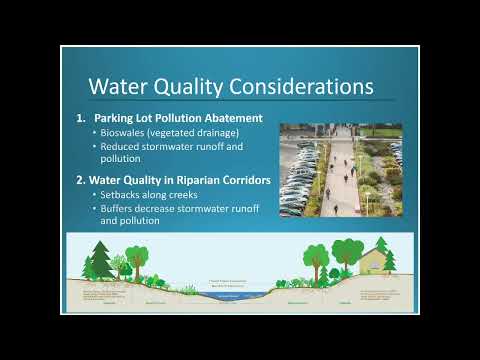
The element also addresses stormwater and water-quality considerations by suggesting riparian setbacks, bioswales and parking-lot landscape changes to filter runoff before it reaches streams and the Great Salt Lake watershed. Brad credited city planners and public works staff for research and analysis used in the draft element and noted the citys recent work on water conservation and infrastructure maintenance.
Council opened the public hearing and heard from Michael and Drana Slaton, who asked how stormwater and water-quality issues — including impaired streams such as Case Creek — would be addressed. Brad described riparian buffers, vegetation preservation and design requirements for new parking areas to reduce pollution and better filter runoff.
After discussion the council closed the public hearing, moved and adopted ordinance 25-24 by roll call vote, with council members stating they expect the general plan to provide guidance and that any regulatory changes would come back through the zoning or ordinance process.
What happens next: staff will integrate the water use and preservation element into the general plan, coordinate with Weber Basin and state agencies as needed, and return with any proposed ordinance changes should the council later choose to pursue regulatory measures.