Get Full Government Meeting Transcripts, Videos, & Alerts Forever!
Get email alerts on the Mobility Fee topic
No spam. Unsubscribe anytime.
Lake City workshop outlines proposed mobility fee to fund $136 million in transportation projects
Summary
Consultant Lauren Rushing presented a draft mobility fee at a Dec. 1 Lake City council workshop, describing a fee schedule by land use intended to fund about 184 multimodal projects with an attributable cost of roughly $136 million; staff was directed to refine the plan and prepare a technical report and ordinance for readings early next year.
Consultant Lauren Rushing told the Lake City council at a Dec. 1 workshop that the draft mobility fee would be assessed only on new development and is intended to mitigate additional trips generated by growth while funding multimodal transportation projects.
Rushing, a transportation planner with New Urban Concepts, said the mobility plan includes about 184 projects with an attributable cost of about $136,000,000 and that the firm will provide a mobility fee technical report to demonstrate the required statutory nexus. "Again, a mobility fee is a fee that's only assessed on new growth. So it's not a tax on existing residents," she said.
Why it matters: The fee is the mechanism the city is considering to pay for a long list of roadway and multimodal projects tied to new development. If the council adopts a mobility plan and fee, staff will also need to amend the city's comprehensive plan within a year of adoption, and implementing procedures for assessment and expenditure will be required.
What the workshop covered: Rushing reviewed the seven‑step implementation process (steps 1–4 are in the current scope) and an 18‑step methodology the consultant uses to calculate rates. She said the calculation looks at the attributable cost of the mobility plan projects, the person‑miles of added capacity, and trip generation rates from the ITE Trip Generation Manual to derive a per‑land‑use fee.
Recommended structure: For a city of Lake City's size the consultant recommended one citywide assessment area (where fees can be collected) and one citywide benefit district (where fees may be spent), arguing that multiple districts would restrict flexibility unless a strong database justification exists.
Rate categories and examples: Rushing proposed streamlined land‑use categories — two residential categories (including an affordable residential category pre‑calculated at 50% of the general residential rate), three institutional categories, four recreational categories (with carve‑outs for golf courses and RV parks), a single industrial category (sample rate cited at $550 per thousand square feet), two office categories (separating medical/dental), and four aggregated retail categories. She also described additive fees to capture extra trip generation from features such as drive‑through lanes, car‑wash stalls, fueling positions and EV charging.
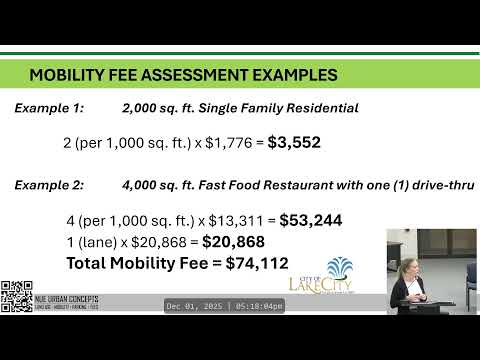
Rushing illustrated the schedule with examples: she said a 2,000‑square‑foot single‑family home would be charged "2 times the applicable rate" (stated in the workshop as $17.76 per unit used in the example) and the speaker presented a final fee figure of $3,552 for that 2,000‑square‑foot example; an 1,100‑square‑foot example was presented as roughly $1,900. For commercial development she said a 4,000‑square‑foot restaurant could face fees of about $53,244 for building area plus roughly $21,000 for a drive‑through lane, or about $74,000 total, to illustrate how commercial projects can generate larger fee amounts.
Legal and documentation next steps: Rushing emphasized the need for a technical report to satisfy Florida statute's nexus and technical requirements. The consultant said staff and the consultant team will update the mobility plan and fee after council feedback, produce the technical report documenting methodology and rates, and bring an implementing ordinance and comprehensive plan amendment to the council for first and second readings early next year.
No formal action recorded: The workshop transcript records presentation and discussion but no formal motions or votes. The next procedural steps described were preparation of the technical report, ordinance drafting, and comprehensive plan amendments for future council readings.
Quotes: "Again, a mobility fee is a fee that's only assessed on new growth. So it's not a tax on existing residents," Rushing said. She also summarized the plan cost: the mobility plan projects "total an attributable cost of about $136,000,000." The consultant recommended "one citywide assessment area" and "one citywide benefit district" for a city of Lake City's size.
What to expect next: Following council feedback, staff and the consultant will update the fee schedule and technical documentation and return with materials for ordinance readings and the required comprehensive plan amendment.