Get AI Briefings, Transcripts & Alerts on Local & National Government Meetings — Forever.
States and EPA pledge funding and projects as council moves to implement revised agreement
Loading...
Summary
Governors and agency officials at the council meeting described new or increased state investments and projects — including Virginia’s multi-hundred‑million allocation boost for best-management practices, New York’s wastewater and tree-planting funding, DC’s sewer-tunnel work, and targeted agricultural reductions — as the council prepares to implement the revised agreement.
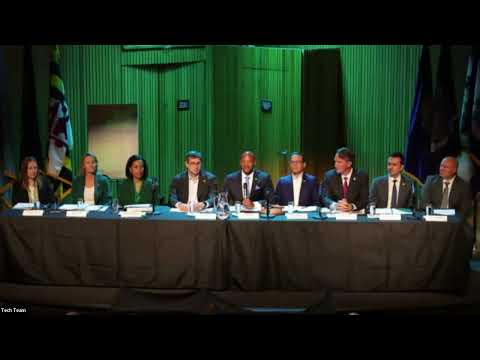
Governors and agency representatives used their remarks during the public portion of the council meeting to outline state and local investments that they said will help implement the revised watershed agreement.
Virginia’s governor highlighted what he described as a major scale-up in state funding for agricultural and conservation best-management practices, saying the Commonwealth had increased annual allocations from $40 million to more than $675 million and reported reductions of "3,000,000 pounds of nitrogen" and "246,000 pounds of phosphorus" from agricultural sources. He also noted permitting-time reductions the state has achieved and described a $22 million investment in oyster restoration that he said helped Virginia meet recent oyster habitat targets.
Delaware’s governor described investments in cover crops, conservation incentives and local monitoring partnerships such as the Nanticoke Watershed Alliance's Creek Watchers program, and said Delaware would sign onto the revised agreement.
Elizabeth Walters from New York’s Department of Agriculture and Markets outlined New York’s watershed spending inside the State (stated as more than $43 million), citing $34 million for wastewater and nonpoint‑source control and $800,000 for aquatic connectivity projects; she also cited the state's tree-planting initiative with more than 130,000 trees planted since January 2024.
A Washington, D.C., official pointed to the city’s Clean Rivers investments and said completed projects have prevented roughly 18.9 billion gallons of combined sewage and trash from entering local rivers; the official noted a future tunnel project also expected to reduce overflows by more than 90% when completed.
West Virginia’s water‑management director said the state met its 2025 nutrient and sediment planning targets and pointed to local improvements, including the removal of an algae impairment on the South Branch Potomac River following nutrient-reduction work.
EPA’s representative reiterated the federal role in funding, data, and technical assistance consistent with its Clean Water Act authorities to support state and local projects.
Numbers and outcomes presented at the meeting were reported by state officials and agency representatives during their remarks; the transcript does not include formal verification or a roll‑call vote for the figures cited. Implementation of many projects will require continued funding flows, permitting and local project delivery.