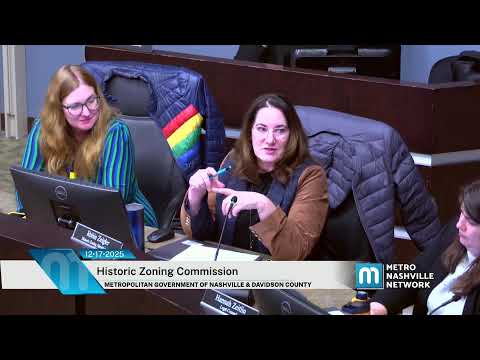
Historic Zoning Commission recommends Green Hills East conservation overlay after heated public hearing over outreach and moratorium
Loading...
Summary
After a multi‑hour public hearing with dozens of residents for and against, the Historic Zoning Commission voted to recommend the Green Hills East Neighborhood Conservation Zoning Overlay and its draft design guidelines to the planning commission and Metro Council; commissioners and many speakers raised concerns about survey methodology and a permit moratorium.
The Historic Zoning Commission voted to recommend adoption of the Green Hills East Neighborhood Conservation Zoning Overlay and the draft design guidelines, forwarding the recommendation to the planning commission and Metro Council after an extended public hearing and commissioner deliberation.
Staff presented the draft overlay and design guidelines, explaining historical context and proposed allowances for rear additions and outbuildings based on the neighborhood’s 1926–1930 development patterns. Councilmember Jeff Prepte described neighborhood outreach and a homeowner poll he conducted, saying he received 72 responses with 51 in favor, 17 opposed and 4 undecided — a figure he calculated as roughly 70.8% support with particular weight given to responses from contributing homes.
During the public hearing more than two dozen residents spoke both for and against the overlay. Those opposed raised concerns about outreach methods (email‑only SurveyMonkey polling that produced a 72‑response sample out of 119 parcels), the equity of applying stricter rules to contributing homes, and a 90‑day moratorium on permits that some residents said was imposed without notice and immediately affected renovation plans. Supporters said the overlay would preserve neighborhood character, referenced an outreach process with meetings and door‑to‑door flyers, and cited the Preservation Society of Nashville’s support.
Key exchanges included: Dr. Bridal Leslie cautioning that an equitable process requires balanced outreach and clear methods for assessing community will; Valley Forrester and others noting the moratorium’s immediate financial impacts on homeowners and saying they were not adequately notified; Dylan Reeves and other opponents asking for transparency and release of raw survey data to verify the 70% figure; preservation advocates and several commissioners defending the staff report’s documentation and saying the commission’s purview is to evaluate historic eligibility rather than neighborhood ballots.
Commissioners debated eligibility standards under the ordinance (items 1 and 3 of the code cited in staff materials). Several commissioners said the staff report met those criteria and supported the recommendation; others expressed serious reservations about the outreach and participation levels but acknowledged that the commission’s role is limited to historical appropriateness.
Commissioner 2 moved — with the friendly amendment to the design guidelines — to recommend approval of the Green Hills East overlay finding the area meets the ordinance criteria; the motion passed in roll call by voice with one commissioner recorded as opposed. The item will proceed to the planning commission and then Metro Council for final action.
Next steps: the planning commission will consider the recommendation on 2026-01-08 and Metro Council will have subsequent hearings; opponents have requested additional transparency on survey methodology and notification practices.