Get Full Government Meeting Transcripts, Videos, & Alerts Forever!
Get email alerts on the Rate Design topic
No spam. Unsubscribe anytime.
PURA resumes Hazardville Water evidentiary hearing; staff presses company on rate design, surcharges and late‑file exhibits
Summary
At a Dec. 4 evidentiary session, PURA staff pressed Hazardville Water Company witnesses for data and clarifications on rate design, allocation, proposed meter and usage increases, and the treatment of WICAA and RAM surcharges. The company agreed to multiple late‑file supplements and to provide hypothetical models for inclining block rates and a two‑year amortization analysis.
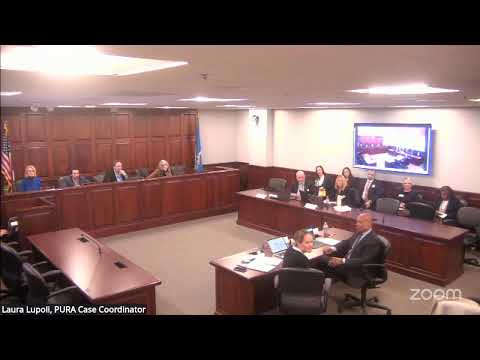
The Public Utilities Regulatory Authority on Dec. 4 resumed an evidentiary hearing in the Hazardville Water Company rate proceeding, focusing on rate design, revenue allocation and outstanding evidentiary supplements.
PURA staff questioned company witnesses about the underlying data supporting proposed rate changes and allocation choices, identified exhibit linkage errors, and converted several read‑in requests into late‑file exhibits. Company witnesses acknowledged a mislinked Schedule E3.O (summary of operating revenues) and agreed to submit a corrected late‑file exhibit and any necessary flow‑through adjustments.
Why it matters: PURA will use these exhibits and the company’s answers to determine whether the requested revenue requirement and rate design are supported. Several technical corrections and supplemental data could change how the proposed increase is allocated across customer classes.
Key figures and corrections Company witnesses confirmed several substantive numerical points during questioning: meter service charge increases for common residential meters (5/8‑inch) are being moderated as part of the allocation; the company said the 5/8‑inch meter charge increase is 55 percent and that the meter equipment averages about $185 while the radio reader is about $140. On debt costs, the company acknowledged an earlier miscalculation and said it corrected its embedded cost of long‑term debt from a reported 3.96 percent to 2.3 percent after annualizing interest expense properly. "We corrected the interest expense, and we came up with a 2.3% embedded cost of long term debt versus the original 3.96," a company witness said on the record.
Staff also confirmed the exhibits omit current WICAA and RAM surcharge dollars that customers pay today; company witnesses said those surcharges are not included in the 'current' columns of the rate exhibits and agreed to submit a late file (Late File 47) showing a comparison of current and proposed rates that uses current WICAA and RAM rates as proxies to make bill‑impact comparisons more transparent. The company said the current approved WICAA surcharge is 10.58 percent and the current RAM surcharge is 8.96 percent.
Rate design and allocation questions PURA staff pressed the company on whether the revenue allocation reflects cost‑causation principles and on the absence of a modern cost‑of‑service study. The company said it had not been required to produce a cost‑of‑service study and had not sought an internal estimate of one, and that producing one would be expensive.
On the allocation method, company witnesses explained they prioritized keeping the 5/8‑inch residential meter charge lower because it is the largest single customer class and the charge is a flat fee. Staff asked whether the remainder of unrecovered meter costs had been distributed evenly across other meter sizes; the company replied that, "for the most part, yes," the remainder was apportioned among other meter sizes.
PURA staff also sought precise percentage comparisons in the record. The company confirmed proposed meter‑rate increases generally fall in the 54–68 percent range, proposed usage rates were increasing by about 69 percent for residential initial tiers, and private fire protection rates show larger percentage changes (roughly 60–85 percent). The company said it had looked at comparable Connecticut water company rates as a benchmark but did not treat that comparator as the primary driver.
Late files and next steps The company agreed to provide or supplement multiple late files and supplemental exhibits, including: - Late File 44: spreadsheet of residential usage for the top 15% highest users (monthly and quarterly) for calendar years 2022, 2023 and 2024, with a hypothetical inclining block rate model using that data; - Late File 47: schedule showing current and proposed rates with current WICAA and RAM included for bill‑impact comparison; - Late File 48: a hypothetical analysis of amortizing the company’s full requested rate increase over two years, including effects on the company’s ability to provide safe and reliable service and the capital plan.
Parties also discussed procedural scheduling of late‑file deadlines and late‑file hearings; commissioners noted the current hearing schedule shows late files due and hearings in mid‑December and said they would consider a motion to move the late‑file due date to Dec. 15 and the hearing to Dec. 18. The chair indicated the evidentiary record is currently scheduled to close on Dec. 18, subject to any scheduling motions.
What’s next: PURA will wait for the late‑file supplements and hypothetical models. These supplements — especially corrected exhibits that capture surcharges and the proposed amortization or inclining‑block scenarios — are likely to be used in commission deliberations about the requested revenue requirement and the distribution of increases across customer classes.