Get Full Government Meeting Transcripts, Videos, & Alerts Forever!
Get email alerts on the Professional Student Definition topic
No spam. Unsubscribe anytime.
Education Department proposes interim ‘professional student’ definition, aims to grandfather some graduate students for one year
Summary
Department staff presented an interim definition of “professional student” through June 30, 2027, intended to preserve the status quo as of July 4, 2025, for programs institutions identified as professional and to allow enrolled students a one‑year transition; negotiators raised concerns about schools gaming marketing to capture the window.
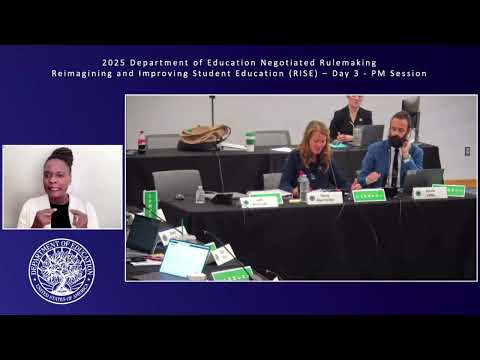
The U.S. Department of Education on Wednesday presented an interim definition of “professional student” that would apply through June 30, 2027, and said the change is intended to preserve the status quo for certain graduate and professional programs while a permanent definition is finalized.
Department staff displayed amendatory language and said the interim definition covers students enrolled before July 1, 2027, in programs that award a professional degree and meet the criteria in three subparts of the definition. The proposal ties one of those subparts to consumer‑facing information required under 34 C.F.R. §668.43 and to program existence at the institutional level as of July 4, 2025.
Why it matters: The classification affects annual Title IV loan limits for graduate students. Under the department’s framing, students enrolled in programs that institutions represented as professional as of the enactment date could continue to access prior loan levels during the interim period, avoiding abrupt reductions for students already enrolled.
What the Department said: A department official summarized the draft language and said the intent is to "continue the status quo before the permanent definition kicked in," giving students and institutions time to adjust. The official also noted a technical reading of the Higher Education Act led staff to revise dates and cross‑references in the draft.
Concerns from negotiators: Multiple negotiators warned the one‑year window could encourage schools to alter marketing materials or reporting to qualify programs as professional. "Schools are going to say that even if they didn't call it a professional program before, they will call it now," one negotiator said, urging clearer limits to avoid a "floodgate" of newly designated programs. Another negotiator suggested using contemporaneous IPEDS reporting or other proxies as evidence of intent; department staff said they would rely on §668.43 consumer information and contemporaneous materials and would edit the preamble to clarify intent.
Department response: Staff acknowledged the risk of "gaming" and said they expect to see contemporaneous evidence that an institution treated a program as professional — for example, links to program descriptions, catalogs, or language indicating a pathway to professional licensure. They said romanette 1 (existence as of 07/04/2025) and romanette 3 (institutional designation) were intended as separate but complementary tests and that they would amend the regulatory text to make the timing explicit.
Unresolved items and next steps: Negotiators asked whether students who enroll during the interim period would be able to complete under the prior rules; the department said the interim language is intended to cover periods of enrollment that begin on or after July 1, 2026, and to allow students in that transition period to continue under prior limits while enrolled. Staff said they would refine the text and the preamble and return to the committee for additional pulse checks. Legal and operational clarifications — including whether certain programs would be treated differently depending on institutional reporting practices — remained under discussion.
The committee did not take a final consensus on this definition during the session; staff said they will circulate updated amendatory text and resume pulse checks in follow‑up meetings.