Get Full Government Meeting Transcripts, Videos, & Alerts Forever!
Get email alerts on the Environment topic
No spam. Unsubscribe anytime.
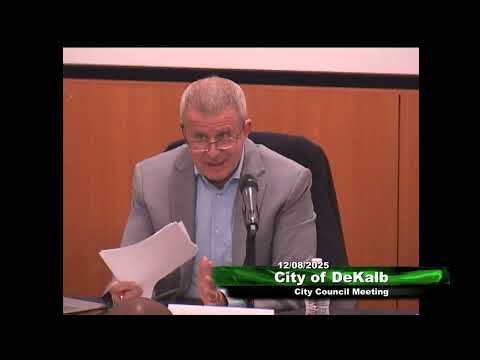
Residents press DeKalb Council on wildlife, noise and utility impacts during Project Vector hearing
Summary
At a packed Dec. 8 public hearing on Project Vector, residents and advocates raised questions about habitat loss, noise, lighting, unproven cooling technology and potential rate and grid impacts; developers and consultants presented mitigation measures including a closed‑loop propylene‑glycol cooling system, TurboCell backup power and a 3‑D noise model showing levels below local limits.
Dozens of residents and local stakeholders spoke during a Dec. 8 public hearing about Project Vector, a proposed four‑building data center slated for roughly 560 acres along Illinois Route 23. Speakers delivered a mix of support and opposition while pressing the council and developer for more technical detail and binding protections before permits are issued.
Wildlife and environment: Kathy Stelford, founder of Oak and Acres Wildlife Center, told council of a nearby bald‑eagle nest and said the project’s footprint and associated light and noise could reduce hunting territory and harm fledgling birds. "These are your neighbors too," Stelford said, calling for stronger wildlife protections.
Residents described potential quality‑of‑life harms. Michelle Miguel, a neighbor in Southpoint Greens, said the closest data‑hall corner would be about 600 feet from her home and voiced concerns about constant 24/7 background noise and inadequate berming near her property. "I just don't wanna hear this at my home," Miguel said, urging higher berms and mature evergreens for screening.
Technical claims from developers and consultants: Developers and technical leads described a closed‑loop, waterless cooling system (ThermalWorks) using food‑grade propylene glycol rather than toxic ethylene glycol, and said the architecture reduces fluid volume per megawatt and isolates fluid loops to avoid site‑wide catastrophic leaks. Jeremy (ThermalWorks) explained the loop and redundant monitoring systems and said the design aims for zero evaporative cooling water usage.
David Morton described TurboCell backup power as a mechanically simpler, lower‑noise alternative to conventional diesel generators and said the design can support the grid and re‑island critical loads during outages. Noise consultant William Bone presented a SoundPlan 3‑D model that placed 14 receptor points and included berms and acoustical walls; he reported daytime receptor levels with the highest modeled daytime number around 50.1 dBA, about 10 dB below the City of DeKalb’s daytime limit of 60 dBA, and nighttime modeled peaks near 47.5 dBA.
Concerns and requests: Many speakers — including data‑center skeptics and residents who said they had spent years on DeKalb farms — called the cooling and TurboCell systems "new" and asked for peer‑reviewed operational data and multi‑year performance studies. Multiple requests centered on four technical documents not displayed in full during the hearing: a full electrical load and transmission impact analysis, peer‑reviewed long‑term cooling performance data, a detailed stormwater/hydrology plan accounting for floodplain and wetlands, and a decommissioning plan for end‑of‑life equipment.
Transparency and costs to residents: George Keane and others asked whether utility upgrade costs would be passed to households and whether tax incentives and non‑disclosure agreements reduce public accountability. Lizzie Maldonado and other opponents cited state‑level environmental goals and argued that approving a gas‑powered backup approach would lock the region into fossil fuel dependence.
Support and local benefits: Proponents — including the DeKalb County Economic Development Corporation, the DeKalb school district, labor unions and many local contractors — said Project Vector will generate substantial construction work, hundreds of well‑paid permanent jobs over time and tens of millions of dollars in tax revenue that benefit schools and local services. Melissa Amidio (DeKalb County EDC) referenced studies estimating statewide tax revenues from data centers and cited Meta's prior tax contributions as precedent for local benefit.
Next steps: Council members and staff repeatedly said the project will continue to be reviewed through engineering and permitting, with additional technical materials to be provided to staff and the public as part of the development and permit review process. Residents asked for formal monitoring and clearer commitments on post‑construction noise monitoring, stormwater control, wildlife mitigation and a transparent plan for how grid upgrades and enterprise zone incentives will be allocated.