Get Full Government Meeting Transcripts, Videos, & Alerts Forever!
Get email alerts on the Economic Development topic
No spam. Unsubscribe anytime.
DeKalb Council approves annexation, rezoning and development agreement for Project Vector data center
Summary
After developer presentations and a lengthy public hearing, the DeKalb City Council voted unanimously to approve an annexation, rezoning to Planned Development Industrial (PDI) and an annexation & development agreement for Project Vector, a proposed four‑building data center to be built on about 560 acres along Illinois Route 23.
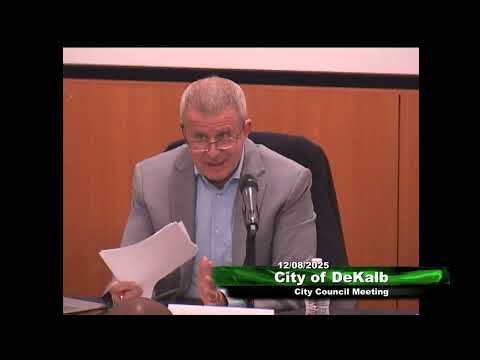
The DeKalb City Council voted on Dec. 8 to adopt a package of ordinances that will annex about 560 acres into the city, rezone the parcels to Planned Development Industrial (PDI) and authorize an annexation and development agreement with JJK 343 LLC for Project Vector, a proposed multi‑phased, four‑building data center campus.
City Manager Bill Nicholas told council that the development plan and background studies total roughly 300 pages and that the Planning & Zoning Commission had unanimously recommended approval. Jerry Krasinski of Krasinski Construction introduced the project during a public hearing, saying the development would be built in phases, include two substations, private funding for road and sanitary improvements, and yield just under 3,000,000 square feet when fully built. "We want to do this responsibly, with sustainability, and sensitive to the surrounding area," Krasinski said during his presentation.
Council members discussed planning, infrastructure responsibility and long‑range land‑use consistency. Alderman Carlson, who represents Ward 4, said he had not signed any non‑disclosure agreements and described the decision as "the biggest decision I've ever made," concluding he supported the project. Following discussion, the council approved the city budget ordinance for 2026 on second reading and then moved the three Project Vector ordinances through first reading and waived second reading votes. Roll call votes recorded unanimous 'yes' from the seven members present (Powell, Larson, Carlson, Verbeck, Walker, Zazata and Mayor Barnes) for each action.
Key details disclosed at the meeting include the development footprint (approximately 560 acres), a project build‑out described by the developer as four data halls totaling just under 3,000,000 square feet, the use of a closed‑loop "waterless" cooling technology supplied by ThermalWorks, and a backup power approach described as "TurboCell" units the developer said are quieter than conventional diesel generators. The developer and consultants presented a noise model showing receptor levels below City of DeKalb and Illinois Pollution Control Board thresholds, cited berm and screening plans (berm heights described in the study at about 7–16 feet), and described private funding commitments for road upgrades and sanitary extensions.
The ordinances passed were:
• Ordinance 2025‑548 — adoption of the annual budget and non‑bargaining unit pay plan for fiscal year 2026 (passed on second reading).
• Ordinance 2025‑550 — authorizing the annexation and development agreement with JJK 343 LLC (Project Vector); motion to bring to floor moved by Alderman Carlson, seconded by Alderman Zazata, approved by roll call (7–0).
• Ordinance 2025‑551 — approving the annexation of approximately 560 acres to the City of DeKalb (first reading approved, 7–0).
• Ordinance 2025‑552 — rezoning the parcels to PDI and approving the development plan and final plat for Project Vector (first reading approved, 7–0).
The council also voted to waive second readings on the Project Vector ordinances and other pending items so the approvals could proceed without delay.
Why it matters: City officials and proponents said the project will expand the city's industrial tax base, produce multi‑year construction employment and generate significant new property and related tax revenue for the city and taxing districts. Opponents had argued the site’s conversion will remove hundreds of acres of natural habitat and raised concerns about noise, long‑term utility impacts and transparency of commercial agreements. The council’s approval sets the process in motion for developer‑led engineering and permit reviews and for state and local oversight of applicable environmental and infrastructure requirements.
What happens next: With annexation and zoning approvals in place, the developer and city staff will continue engineering, permitting and phased construction. Several residents and stakeholders urged continued community engagement and additional technical reporting (transmission impact, stormwater, and operational performance data) before subsequent approvals or building permits are finalized.