Get Full Government Meeting Transcripts, Videos, & Alerts Forever!
Get email alerts on the Rv Regulation topic
No spam. Unsubscribe anytime.
Opa-locka workshop outlines regulated plan to allow parked RVs in single-family and duplex zones
Summary
City staff presented draft amendments to allow certain recreational vehicles to park on R-1 and R-2 lots under conditions including a 35-foot limit, annual registration with a $150 fee, annual inspections (or on complaint), prohibition on occupancy and utility hookups, and $500 penalties for violations. Residents raised concerns about fees, inspections and enforcement.
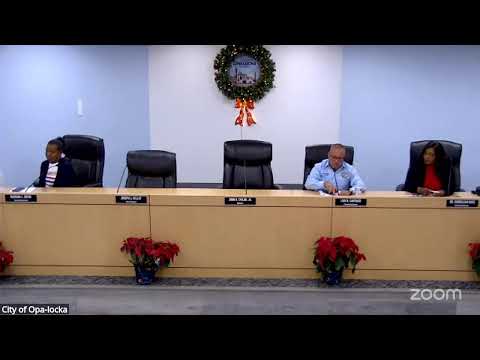
Opa-locka — City staff on Dec. 11 presented a draft ordinance change that would allow certain recreational vehicles (RVs) to be parked on single-family (R-1) and duplex (R-2) lots under strict conditions, while reaffirming prohibitions on using those vehicles for housing.
The presentation, led by the city manager with staff assistance from Gerald Lee and Executive Secretary Romani Branch, listed the proposal’s chief elements: a 35-foot maximum length, a requirement that RVs remain on wheels and be fully visible, annual city registration with a $150 fee and an affidavit that the vehicle will not be used as a dwelling, annual inspections (or additional inspections upon complaint or if patrol observes suspected occupancy), a ban on hookups to city water, sewer or electricity, and penalties for violations.
“Esta va a ser la última noche ya para nosotros poder llegar hasta donde hemos luchado tanto,” the city manager said as staff framed the measure as a way “to embellecer a nuestra ciudad” and protect residential property values. Staff reviewed Section 22-116 of the city code and said the amendment would modify a 2024 rule (referred to in the presentation as 2024-11) that had prohibited RV storage in residential zones.
Why it matters: the change would reverse a recent prohibition and create a regulated pathway for owners who want to keep RVs on private lots without converting neighborhoods into informal RV parks. Staff said the rules aim to balance resident property rights, neighborhood appearance and public-safety concerns.
Residents at the workshop expressed a mix of support and worry. Luis Gálvez, who gave his address to the commission, said he was concerned about perceived invasiveness of inspections. “La casa es mi templo, yo permito entrar a quien yo quiera,” Gálvez said, adding that he feared frequent visits and that inspections might become intrusive.
Several speakers asked who would be fined and whether penalties could stack. One resident posed a hypothetical in which repeated violations could yield multiple $500 fines, asking, “¿Eso significa que yo voy a recibir una multa de 2000 dólares en esa visita?” Staff replied that cumulative fines are possible and that payment plans would be available for residents who could not pay immediately.
On enforcement mechanics, staff acknowledged limits and said the city would consult Florida law and the city attorney about remedies. When asked if the city could cut water or electric service for violations, the city manager said, “La ciudad no tiene nada en determinado para poder cortar esos servicios, así que tenemos que pensar en algo más,” and later promised to review the legal pathway.
Technical limits and inspections: staff said inspections would generally be annual after registration and could occur earlier if there is a complaint or a patrol observation suggesting an RV is being used as a dwelling. The draft prohibits connections to water, sewer or electricity; staff explained that limited electrical maintenance might be necessary to preserve equipment but permanent utility hookups to city systems would be disallowed.
Costs and administrative details: the draft would require owners to register each RV with the city annually and pay a $150 fee, display current vehicle registration and license plates, and sign an affidavit certifying the RV will not be used for habitation. Violations could result in fines of $500, removal at the owner’s expense, administrative adjudication or permit revocation, according to staff.
Next steps: staff said the city has held prior workshops on the subject and is preparing an implementation plan. The manager told commissioners he expects the ordinance to return for a second reading in February. “Yo voy a reducir ese precio,” the manager said during public comment, indicating he would discuss lowering the fee with colleagues.
What remains unresolved: residents pressed for clarity on whether multiple RVs on one property would be allowed and how repeated violations would be tallied; staff said those details would be refined in coordination with the city attorney and administration. The presentation invoked Florida law (transcript reference to Fla. Stat. §812.014 regarding theft was mentioned during a broader discussion of repeat offenders) and code section 22-116 was cited as the provision to be amended.
The workshop closed with staff thanking attendees and promising a revised draft and follow-up at the next hearing. No formal vote was taken at the workshop.