
Commission approves Adams Farm development agreement after residents press drainage and density concerns
Get AI-powered insights, summaries, and transcripts
Subscribe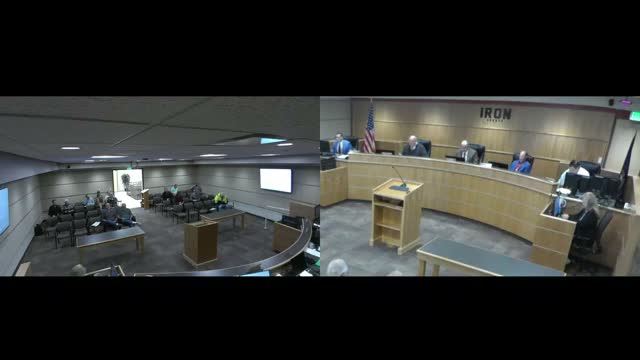
Summary
Iron County commissioners approved a development agreement for the 77.45‑acre Adams Farm subdivision, allowing a mix of lot sizes and up to 120 clustered townhome units while requiring oversized drainage measures after nearby residents raised flooding and traffic concerns.
Iron County commissioners on Monday approved a development agreement with DDJ Development LLC to allow the Adams Farm subdivision on about 77.45 acres at the northeast corner of 3200 North and 2300 West in Cedar City. The agreement sets a maximum residential density averaged across the project and limits the clustered townhome component to no more than 120 units.
Tyler Melling, the project representative, told the commission the master plan calls for a mix of lot sizes — from 1‑acre parcels on the north edge down to smaller single‑family lots and a clustered townhome area in the southeast corner. He said the development will include a centralized drainage basin and public trails and that the county’s code would require off‑street storage to accommodate vehicles and trailers. "We oversized it," Melling said, describing the drainage design: the dedicated basin will accommodate a 25‑year rainfall event, park overflow up to a 100‑year event, and the outdoor storage area is designed for a 250‑year event.
Nearby residents urged the commission to lock in lower densities adjacent to existing subdivisions and to ensure drainage would not flow into their yards. "The main concerns we have had about this development is, of course, the high density being butted up against the back of our subdivision," said Lori Brown, HOA president of Monarch Meadows, who described prior incidents when upstream changes had overwhelmed local drainage and required emergency sandbagging. David Price, another Monarch Meadows resident, urged the commission to require that the one‑acre and half‑acre lots along the project's northern edge remain as shown and not be converted to higher‑density parcels.
Melling and county staff responded that the development agreement includes language preserving one‑acre lots at the northern project border and that each future subdivision phase will be required, at certificate of occupancy, to grade lots to retain stormwater on site and comply with county drainage standards. Melling added the project will establish an HOA (and associated CCRs) to provide enforcement of retained‑stormwater requirements.
Commissioners debated the changes recommended by the planning commission, including a correction to the townhome cap that reduced the previously stated 140 units to a not‑to‑exceed 120 units. After discussion and a motion to approve the development agreement with that modification, the commission voted by voice to approve the agreement.
What happens next: the development agreement vests the project's rules as written and requires the developer to return for required subdivision approvals and certificate‑of‑occupancy inspections. The applicant said approvals, detailed subdivision plats and CC&Rs will follow and that the overall buildout could span many years under the terms of the agreement.