Get Full Government Meeting Transcripts, Videos, & Alerts Forever!
Calimesa hearing officer hears dispute over mobile‑home park cost pass‑throughs as residents object
Summary
At a Dec. 9 public hearing, California Mobile Home Estates asked to pass through costs for road replacement, park lighting, pool/spa repairs and a clubhouse/roof remodel to residents. City staff, residents and the petitioner disputed whether the work qualifies as capital improvements, whether 51% resident consent exists and whether the costs are the owner’s maintenance responsibility.
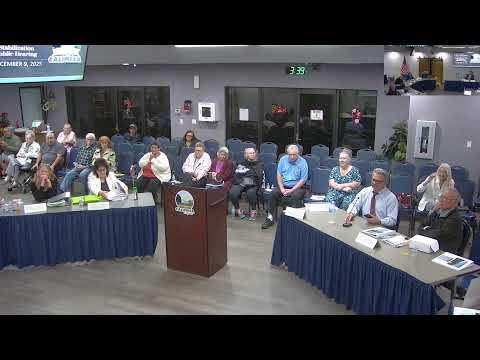
A Calimesa hearing officer heard hours of testimony on Dec. 9 on a petition from California Mobile Home Estates seeking to pass through capital‑improvement costs and temporary hearing costs to the park’s residents.
The petition asks to recover several projects: a street replacement project (staff listed a project cost of $646,453 and proposed a $49.05 per‑space monthly pass‑through over 15 years in one option), solar street lighting (staff and petitioner discussed figures ranging from $1.77 to $2.44 per space per month), pool and spa work (shown in the filing as $4.80 per space per month for 15 years in one option) and a clubhouse and roof project for which the petitioner seeks partial recovery ($136,736 of an alleged $234,002.77 total). The petitioner also seeks a temporary rent increase to amortize petition and hearing costs; petitioner counsel calculated $6.97–$7.23 per space per month depending on the interest rate applied.
Why the hearing matters: under the Calimesa Municipal Code the hearing officer may authorize capital‑improvement pass‑throughs only after finding that (1) the work qualifies as a capital improvement, (2) documentation and vote requirements are satisfied (51% of occupied spaces must consent) or, absent that consent, (3) the work was necessary to protect health and safety. The ordinance also limits the interest rate available for temporary cost recovery.
What staff told the hearing: city staff recited the petition timeline and said the petitioner’s initial filing was incomplete until…
Already have an account? Log in
Subscribe to keep reading
Unlock the rest of this article — and every article on Citizen Portal.
- Unlimited articles
- AI-powered breakdowns of topics, speakers, decisions, and budgets
- Instant alerts when your location has a new meeting
- Follow topics and more locations
- 1,000 AI Insights / month, plus AI Chat