Get Full Government Meeting Transcripts, Videos, & Alerts Forever!
Get email alerts on the Mobile Home Parks topic
No spam. Unsubscribe anytime.
Calimesa hearing officer hears dispute over mobile‑home park cost pass‑throughs as residents object
Summary
At a Dec. 9 public hearing, California Mobile Home Estates asked to pass through costs for road replacement, park lighting, pool/spa repairs and a clubhouse/roof remodel to residents. City staff, residents and the petitioner disputed whether the work qualifies as capital improvements, whether 51% resident consent exists and whether the costs are the owner’s maintenance responsibility.
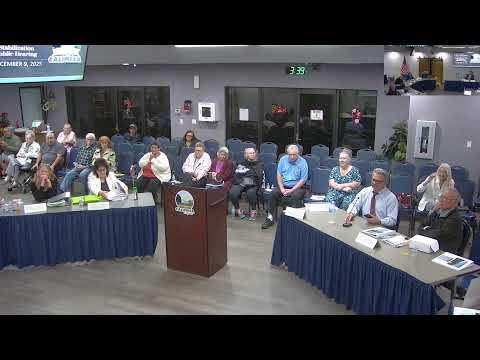
A Calimesa hearing officer heard hours of testimony on Dec. 9 on a petition from California Mobile Home Estates seeking to pass through capital‑improvement costs and temporary hearing costs to the park’s residents.
The petition asks to recover several projects: a street replacement project (staff listed a project cost of $646,453 and proposed a $49.05 per‑space monthly pass‑through over 15 years in one option), solar street lighting (staff and petitioner discussed figures ranging from $1.77 to $2.44 per space per month), pool and spa work (shown in the filing as $4.80 per space per month for 15 years in one option) and a clubhouse and roof project for which the petitioner seeks partial recovery ($136,736 of an alleged $234,002.77 total). The petitioner also seeks a temporary rent increase to amortize petition and hearing costs; petitioner counsel calculated $6.97–$7.23 per space per month depending on the interest rate applied.
Why the hearing matters: under the Calimesa Municipal Code the hearing officer may authorize capital‑improvement pass‑throughs only after finding that (1) the work qualifies as a capital improvement, (2) documentation and vote requirements are satisfied (51% of occupied spaces must consent) or, absent that consent, (3) the work was necessary to protect health and safety. The ordinance also limits the interest rate available for temporary cost recovery.
What staff told the hearing: city staff recited the petition timeline and said the petitioner’s initial filing was incomplete until supplemental materials were accepted; staff emphasized the ordinance’s documentary requirements (invoices, proof of resident notice and ballots, election results) and flagged gaps in how some items were documented. Staff also pointed out an ordinance/rule discrepancy on the temporary increase interest rate and used the ordinance rate (7%) in its calculations. Staff told the hearing officer that some items in the petitioner’s submitted cost totals—about $12,000 identified in the hearing—appear to be furnishings or soft‑goods that would not ordinarily meet the municipal definition of a capital improvement and therefore should be excluded from any pass‑through calculation.
Petitioner’s case: the petitioner’s attorney, Mark Albert, and owner Peter Wang argued the projects meet the municipal definition of capital improvement and that many of the works were necessary for health and safety. Contractor John Reimer, sworn as a fact witness, described roads that “looked like cobblestone” and standing water, replacement of drainage/flow lines, installation of dozens of solar lights, major pool and spa repairs (jackhammering liners, adding dual drains, automated chemical monitoring) and interior clubhouse work including flooring, ADA‑compliant counters and roof coating. Wang testified some work was identified or progressed after purchase (notably pool/spa work following contractor and HCD input) and said the packet includes resident notices and ballots for several project surveys; his team reported some votes circulated in October 2023 for roads/lighting/clubhouse and a later survey for pool/spa in spring 2024.
Resident and public response: resident representative Donna Johnson and more than two dozen park residents opposed the petitions. Residents filed a formal written protest (Exhibit 12) arguing the petitions lacked necessary documentation (undated photos, missing invoices), that some work was performed or paid by the prior owner before sale, and that long‑running maintenance failures (puddling/poor grading, dark walkways, restricted clubhouse amenities and a partially unusable pool) reflect owner maintenance obligations rather than chargeable capital improvements. Residents repeatedly said passing the costs to seniors on fixed incomes would be unaffordable. Several residents and a park manager (Catherine Dittes) said some clubhouse renovations were completed under prior ownership before the sale; others said they had asked for, and sometimes received, notices and ballots about proposed projects.
Key disputes for the hearing officer to decide: whether each claimed project satisfies the municipal definition of a capital improvement rather than ordinary repair or deferred maintenance; whether the petitioner submitted the statutorily required documentation for each claimed improvement and for the resident vote; whether the 51% consent threshold was met (staff and residents contend it was not for any of the four project categories); and, if the petition lacks 51% consent, whether each project nevertheless qualifies for the health‑and‑safety exception in CMC 9.05.0.09(c).
Representative quotes from the hearing: resident representative Donna Johnson said in her written protest, “the residents do not agree to the capital improvement pass through” and later told the hearing officer residents “do not owe anything at all” because the work is maintenance or was paid by the prior owner. Contractor John Reimer described the pre‑work road condition: “They looked like cobblestone.” City staff noted the procedural shortfalls and the interest‑rate rule: in staff’s summary the ordinance requires 7% interest for a temporary rent increase even though the petitioner initially calculated at 8.5%.
Process next steps: the hearing officer closed the record and said he will issue a written decision. He announced a target: issuance of his written decision within 45 days of the hearing; the decision will be mailed to parties and triggers the 15‑day appeal period to the city council under the municipal code.
What remains unresolved in the hearing: the record contains competing factual narratives on whether major elements of the clubhouse/roof work were performed by the prior owner (and if so, how that affects eligibility), whether adequate resident consent documentation exists, and whether particular repairs were ordinary maintenance or capital work necessary for health and safety. The hearing officer’s forthcoming written decision will identify which findings are supported by substantial evidence and whether any pass‑throughs or a temporary increase will be allowed.