Sarasota County Schools begins train‑the‑trainer program to standardize customer service
Summary
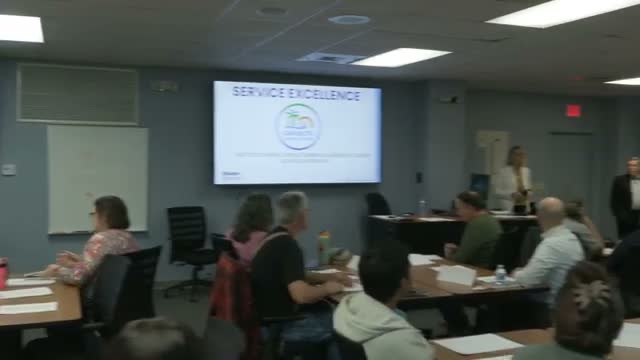
Sarasota County Schools held a 'train-the-trainer' service‑excellence session where Studer Group trainers demonstrated tactics — 5/10 greetings, a 60‑second acknowledgement and AIDET‑style scripts — provided manuals and assigned trainers to take the program into departments; materials will be emailed and sessions recorded.
Sarasota County Schools convened a train‑the‑trainer session aimed at standardizing customer‑service behaviors across departments, introducing frontline staff to techniques trainers will use districtwide.
The session opened with district staff explaining that attendees were selected by supervisors to act as trainers and influencers. Brent of the Studer Group led most of the instruction, describing a full trainer manual (slide deck and scripts), participant handouts and a digital copy that the district will email to attendees. Facilitators said only about 25 printed manuals were available and asked trainers to keep theirs because reprints won't be routine.
Trainers introduced several concrete tactics trainers are expected to teach: the 5‑/10‑foot greeting (visual acknowledgement at roughly 10 feet, a brief verbal greeting at about 5 feet), a 60‑second rule (acknowledge a visitor within 60 seconds, ideally within 30), and a brief AIDET‑style script for entering someone’s workspace (acknowledge, introduce, state duration, explain the service, thank the person). Brent said, "Service excellence doesn't happen by accident," and framed these tactics as ways to reduce visitor anxiety and improve first impressions.
The meeting included demonstrations and roleplays. In one exercise a participant playing a parent was escorted to the main office; facilitators called the interaction an "8‑plus" example. Trainers were shown how to adapt examples for specific verticals (custodial, food service, facilities) and instructed to have trainees write short scripts tailored to common calls or visits in their roles.
Facilitators emphasized phone and written communication. Brent urged staff to "practice smiling when you answer the phone," to state who they are and where callers reached, and to verify details when callers present incomplete information. The session linked the tactics for phone, email and voicemail; trainers were assigned to review and, if needed, update voicemail messages to match the new standards.
The session was recorded for staff who could not attend and the trainers were told they would return for a second session to cover the remaining tactics and later present tactics back to the facilitators for feedback. Materials, a schedule for follow‑ups and the digital trainer manual will be distributed by email before the next session.
The training is presented as the district’s first step in re‑launching an organizational‑excellence effort and is targeted at frontline staff who most frequently interact with parents, community members and vendors. The district framed the effort as part of its broader strategic push to improve public experience across schools and operational departments.