Get Full Government Meeting Transcripts, Videos, & Alerts Forever!
Get email alerts on the County Budget topic
No spam. Unsubscribe anytime.
Larimer County adopts amended 2025 budget and unanimous 2026 budget that incorporates $18.7 million early-childhood sales tax
Summary
The Larimer County Board of Commissioners unanimously approved six resolutions Dec. 11, 2025, amending the 2025 budget, adopting the 2026 county budget (including an $18.7 million voter-approved early-childhood sales tax), setting mill levies for county and other local authorities, establishing 2026 spending limits, designating ending fund balances, and delegating mill-levy certification to staff.
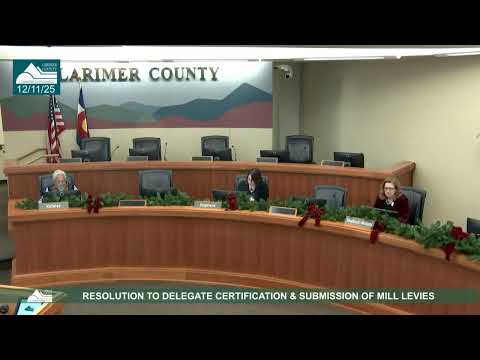
Kristen Stephens, chair of the Larimer County Board of County Commissioners, opened a special meeting Dec. 11 to finalize budget actions for 2025 and adopt the 2026 county budget. The board voted unanimously, 3–0, to approve six resolutions that together amend the 2025 budget, adopt the 2026 county budget and mill levies, adopt budgets and levies for county-managed improvement districts and other local taxing entities, set legal spending limits for 2026, designate ending fund balances, and delegate certification of mill levies to staff.
Matthew Behanan, the county’s senior budget analyst, told the board the adopted 2026 budget differs from the proposed version primarily because of a voter-approved early-childhood sales tax that was certified after the proposed budget was released. “The biggest is the early childhood sales tax passed, that was, after the proposed budget was released,” Behanan said, adding the measure accounts for roughly $18,700,000 in additional spending. He said other adjustments reflect final certification of property values and corrections to a few errors, resulting in a total increase of just over $19,000,000 between the proposed and adopted budgets.
Behanan also explained the need for reductions and program reviews in recent months after a special legislative session reduced future property-tax revenues, particularly for commercial rates. “As a result of the special session from, a year ago where property tax revenues were reduced by the state assembly … we’ve had to adjust our spending to align with the reduction in property tax revenues,” he said.
County manager Lorenda Volker thanked departments and elected offices for proposals and collaboration, and said the adopted package should avoid cutting services. “There may be a slightly longer wait time someplace, but we’re not actually ending any services,” Volker said.
The board acted on the six resolutions in sequence. Commissioner Jody Shattuck McNally moved the first three motions: to amend the 2025 budget; to adopt the 2026 county budget and set Larimer County mill levies; and to adopt 2026 budgets and set mill levies for other entities listed on the agenda (including county-managed improvement districts, the public trustee’s office and the Larimer County Pest District). Behanan noted two new improvement districts included in the package: Nedret Acres and Thunder Mountain.
Commissioner John Kefalas moved the final three motions: to appropriate sums (establishing legal spending limits for each county spending agency for 2026), to designate 2026 ending fund balances, and to delegate authority to the county’s Director of Performance Budget and Strategy to certify and submit mill levies to the assessor and appropriate state agencies. Behanan told the board the TABOR (Taxpayer Bill of Rights) emergency reserve was set at $11,000,000; total ending balances across funds and reserves were listed at $361,600,000.
All six motions passed on voice votes with three ayes and zero nays recorded.
The board also noted the county administers mill-levy certification and tax collections for many local taxing authorities. Behanan estimated there are about 70 county-managed public improvement districts and roughly 400 total taxing authorities (including school districts, municipalities and other special districts) for which the county collects mill levies.
The chair closed public comment after confirming there were no in-person or call-in speakers. Stephens thanked County Assessor Bob Overbeck for his attendance, reminded the public that detailed budget documents are available online, and adjourned the meeting at 10:22 a.m.
What happens next: the adopted budgets and certified mill-levy information will be used by the assessor’s office to finalize property tax notices to households; the board delegated procedural authority to county staff for timely certification to state agencies.