Lifetime Citizen Portal Access — AI Briefings, Alerts & Unlimited Follows
Guam agencies tell lawmakers they’ve narrowed testing and sought federal probes as dieldrin response continues
Loading...
Summary
GWA, Guam EPA, DPHSS and DOAg updated the Legislature on monitoring, interim and permanent treatment systems, a Feb. 27 deadline for a Joint Region Marianas investigation plan and a requested ATSDR public health assessment; agencies stressed better public notification and funding needs for broader testing and an epidemiologic study.
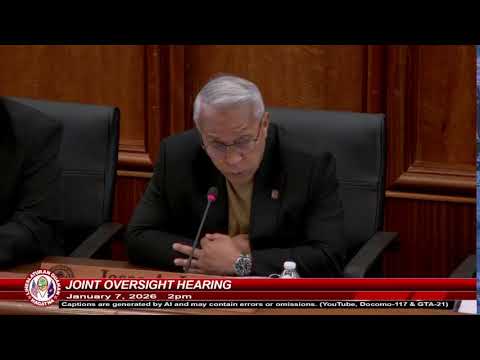
Chair opened a continuation of the joint oversight hearing on dieldrin contamination in Guam’s water at 2:04 p.m., saying residents “deserve timely, clear notice and a coordinated response when public health is at risk.”
Agencies told senators they are moving from identification to coordinated response. Brett Raley, assistant general manager for engineering at Guam Waterworks Authority (GWA), said GWA awarded a contract to begin installations of point-of-entry (POE) household treatment systems and that as of Jan. 5 about 313 households had applied for POE installations and 44 had submitted reimbursement requests. He said Y‑15’s interim treatment system has produced non‑detect results for dieldrin at the point of entry since it went online; other well tests from Dec. 18 reported results between 0.08 and 0.19 parts per billion for several wells. GWA said permanent granular activated carbon vessels for Y‑15 have arrived and that construction of permanent systems at three sites is contractually due by summer 2026, with Y‑15 possibly completing earlier.
Captain Elizabeth DeGrange, senior science advisor at Guam EPA, said the agency conducted two additional farm inspections with the Department of Agriculture and found no evidence of illegal pesticide storage or use at those locations. Guam EPA and U.S. EPA sent a joint letter to Joint Region Marianas (JRM) requesting an investigation plan for possible dieldrin sources on Andersen Air Force Base; Guam EPA said JRM acknowledged receipt and was asked to provide an investigation plan by Feb. 27, 2026. Guam EPA also requested a public health assessment from the Agency for Toxic Substances and Disease Registry (ATSDR) that would include dieldrin, chlordane and PFAS.
Guam EPA described efforts to use hydrology maps and decades of groundwater monitoring reports to narrow likely source areas and sample strata. The agency estimated that expanded testing—55 sites with multiple sample types including tissue, water, sediment and soils—could cost roughly $25,000–$100,000 for comprehensive analyses (agency estimate), and said it is seeking federal lab support and other funding to expand sampling.
Leilani Navarro, environmental public health officer at the Department of Public Health and Social Services (DPHSS), said DEH‑regulated establishments in the Santa Rosa area that had been closed were permitted to operate since December after testing; DPHSS reported that three vending machines sampled were non‑detect and reopened. DPHSS calculated the department’s personnel cost for 20 inspections of 11 facilities as approximately $862 but said that figure excludes administrative and coordination costs.
Patrick Soto, territorial epidemiologist for DPHSS, said surveillance has found zero reported clinical cases of pesticide poisoning to date. DPHSS has requested $3,291,147 in congressional funding to support a proposed epidemiologic study that the department estimates could involve blood draws and testing for roughly 7,000 people (estimate based on ratepayer counts and household size) and would be used alongside an ATSDR assessment to evaluate population‑level health impacts.
Senators repeatedly pressed agencies about who leads each step of the response and how and when the public will be notified. Juliana Mendoza of Guam EPA’s Safe Drinking Water Program summarized notification tiers: an exceedance of the 0.5 ppb interim action level would require affected customers to be notified within 24 hours (tier 1), while a 0.2 ppb exceedance (tier 2) carries up to 30 days to notify and triggers increased monitoring.
Agencies said they now hold frequent communications—several times a week—with federal and local partners and will work with oversight chairs and village mayors to provide briefings and clearer, nontechnical summaries for the public. Guam EPA emphasized it is also pursuing long‑term evaluation through ATSDR and additional sampling outside base boundaries to assess soil and crop bioaccumulation.
The hearing added a private‑sector demonstration: Jeremy Regis of AWG Micronesia presented atmospheric water generators as an alternative source that draws potable water from humidity and suggested they could supplement supplies while contamination remediation continues.
Chair closed the hearing, reiterated expectations for sustained coordination, and confirmed the John T. Cruz confirmation hearing (GRTA) was postponed to Feb. 23, 2026, at 9 a.m. The hearing adjourned at 3:57 p.m.