Lifetime Citizen Portal Access — AI Briefings, Alerts & Unlimited Follows
Guam senators, residents press to withdraw draft 2025 DOD programmatic agreement, demand full Section 106 consultations
Loading...
Summary
At a March 11 public hearing on Resolution 144-38, senators, preservation professionals and residents sharply criticized the draft 2025 programmatic agreement governing Department of Defense undertakings on Guahan, citing missing appendices, reduced reporting, a 30‑day default approval window and risk of expanded land acquisition; the Guam SHPO defended the draft but agreed to a roundtable and additional review.
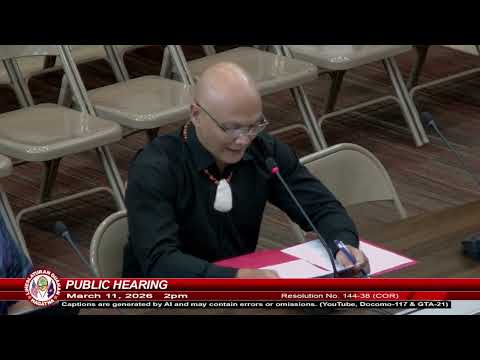
Chair opened a continued public hearing on Resolution 144-38, which calls for withdrawing the draft 2025 programmatic agreement and the 2008 programmatic agreement and restoring full implementation of Section 106 of the National Historic Preservation Act for Department of Defense undertakings on Guahan. The measure drew testimony from the Guam State Historic Preservation Officer and nearly a dozen preservation professionals, residents and advocates.
Patrick King Eluhan, Guam State Historic Preservation Officer, told the committee he supports transparent public input and defended the 2025 draft as the product of multi-year negotiation intended to strengthen institutional commitments, update archaeological-probability mapping and improve reporting. "I assure you that every single voice is being heard, assessed, and addressed," Eluhan said, and he offered Section 106 training for the Legislature and an openness to further edits and a roundtable after the public-comment window closes.
Members of the public and several expert witnesses urged a different course. David Lotz, a longtime preservation practitioner, said he was "not convinced that there's a need for a programmatic agreement" and urged case‑by‑case Section 106 reviews when appropriate. Balthazar Ugan told senators the draft is a "strategic reset" that risks erasing 18 years of oversight and called it "a land grab in disguise," warning that an undefined "area of potential effect" could permit future land acquisitions without clear public notice.
Witnesses and senators repeatedly pressed Eluhan on several concrete concerns: missing appendices and maps that would identify the agreement's "area of potential effect"; the absence of quarterly notification and reporting for medium and high archaeological‑sensitivity sites in the draft's stipulations; language that appears to codify a 30‑day deemed concurrence if SHPO does not respond; and a clause members read as allowing the agreement to take effect without explicit multi‑party signatory confirmation. On each point, senators asked whether the 2008 agreement had been amended or applied to projects (including missile defense work) that postdate it, and sought an accounting of how the 2008 PA had been implemented.
Eluhan said the draft carries forward some federal timing conventions (including the 30‑day Section 106 response window) because the statute and federal guidance provide that outcome; he also said the draft can be adjusted where legally permissible and that he would review specific line edits flagged by senators. He repeatedly offered to compile comment summaries and to host a roundtable: "My door has always been open," he said, and proposed two weeks after the March 20 comment deadline to gather and share consolidated input for a cleaner draft prior to public roundtable discussion.
Several witnesses proposed specific fixes if the draft is revised rather than withdrawn. Kyle Reardon, an archaeologist, recommended restoring more frequent public reporting (quarterly), providing public, nonsensitive versions of sensitivity maps, adding public summaries of twice‑annual reports, and creating a formal cultural‑monitoring and burial‑council structure that would guarantee community participation in discoveries and disposition decisions. Jaren Saralu and others asked the draft to specify who records newly encountered resources, who determines eligibility for the National Register of Historic Places, and what timelines apply to notification and audits.
Committee members emphasized a need to reconcile process and outcomes. Some senators said withdrawal is the only reliable way to compel the Department of Defense and Joint Region Marianas to reengage in deeper consultation; others urged that the benefits Eluhan described (repository commitments, training and specific projects) should proceed regardless of the PA's ultimate status. The Chair announced an oversight hearing on March 18 and reminded the public how to submit written testimony and comments; Eluhan said he will continue to accept and evaluate comments after the March 20 deadline and will work with senators to schedule a roundtable.
No formal motion or vote occurred during the March 11 session. The hearing record will be used to inform the oversight hearing and any future drafting or legislative steps.