
Teacher presents sabbatical on bias-awareness protocols for classroom assessments
Get AI-powered insights, summaries, and transcripts
Subscribe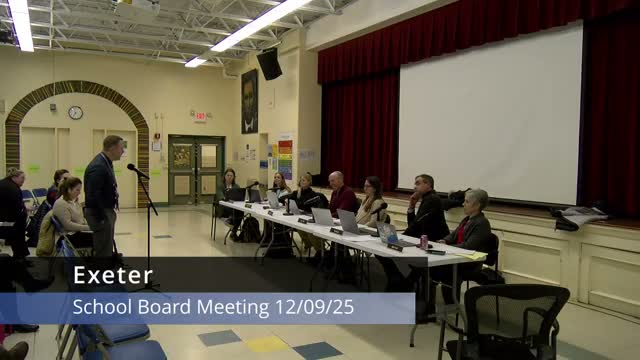
Summary
A Main Street School teacher, Miss Lupina, described a sabbatical project developing bias-awareness protocols for selecting, administering and scoring classroom assessments, training curriculum coordinators and piloting customized comprehension checks to produce fairer, more useful classroom data.
Miss Lupina presented a 25-minute sabbatical report to the Exeter School District board describing an action-research project on implementing bias-awareness protocols when creating and scoring classroom assessments.
She told the board she took graduate coursework in assessment and cultural competency, then piloted protocols across SAU 16 elementary schools to refine test specifications, add deeper (DOK 2–4) items where appropriate, develop rubrics for more consistent scoring and implement customizable comprehension checks in I-Ready so teachers can create form A/form B pre- and post-assessments. She said the work aimed to make classroom assessments more reliable, valid and fair and to provide teachers with immediate, actionable data.
Miss Lupina described working with curriculum coordinators and grade-level collaborative teams to apply the protocols in real classrooms and to reduce over-assessment by emphasizing formative checks integrated into instruction. She said the district can use rubric-driven blind scoring and automated reporting to surface why a student received a particular score and to guide reteaching or enrichment.
Board members asked whether the district is "over-assessing" students; Miss Lupina said the sabbatical’s focus increased staff dialogue about assessment quality and that the approach favors more frequent, short formative checks rather than lengthy summative tests. She recommended continued training for teachers and roll-out across schools, and offered to share the fuller 25-minute presentation and a 46-page literature review that accompanied the sabbatical.
The board acknowledged the presentation and moved on to other agenda items.