
Exeter board models FY27 budget assuming district covers school meals for half of students; pauses family charges through Jan. 5, 2026
Get AI-powered insights, summaries, and transcripts
Subscribe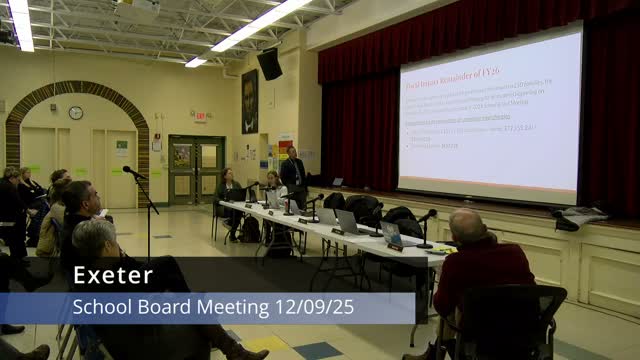
Summary
The Exeter School District board discussed risks to federal funding and the local budget from suspending meal charges, voted to present a FY27 budget scenario that assumes no family meal contributions and 50% student meal utilization, and extended the temporary pause on family payments through Jan. 5, 2026.
The Exeter School District board on Dec. 9 voted to present a revised FY27 budget scenario that assumes the district will not collect family payments for school meals and models meal usage at about 50% of students, while also extending a temporary pause on guardian meal charges through Jan. 5, 2026.
Board members spent the bulk of the meeting pressing staff for clarity on two sets of fiscal figures presented by district administrators: an illustrative remainder-of-year exposure of about $355,000 if the district covered breakfast ($2) and lunch ($3.15) for every student for the rest of the school year, and a larger projected impact (roughly $840,000) that staff said reflected broader next-year effects on federal reimbursements and related formula funding. Finance staff explained the larger number includes projected reductions in Title and adequacy funding tied to fewer completed free and reduced-price meal applications.
The administration told the board the line in the proposed FY27 budget that appropriates the operating cost of the food-service program is $325,000, which covers staff, food and equipment under current revenue assumptions; staff reported last year’s food-supply expenditures were about $65,000 at Main Street and $61,000 at Lincoln Street and that parent contributions totaled about $160,000. Staff said an illustrative figure that would cover every student’s meals for the year was $575,981; they also noted that the $840,507 figure reflects the combined effect of lost parent revenue and impacts to federal grant allocations and adequacy calculations.
Board members debated how conservative to be in the public-facing budget. Some members argued the district should model a worst-case exposure so taxpayers see the full potential cost; others urged a more realistic estimate tied to historical usage and the pandemic-era experience when meals were free. "If kids are getting a meal now and we pay the fund balance, what is the cost to those families versus the cost to the district?" one member asked, urging staff to weigh both financial and social impacts in the decision.
By voice vote the board approved presenting a FY27 proposal to the public hearing that removes family meal charges and assumes 50% meal utilization for breakfast and lunch; members directed administrators to prepare the necessary budget lines (the food-service appropriation and the food-service management/bad-debt line) to reflect that scenario. Earlier in the meeting the board also voted unanimously to set the proposed and default grant-appropriation numbers to match so the same federal grant figure appears in both budget documents, a procedural step staff said can later be adjusted after public input.
During discussion administrators advised that reductions in completed free/reduced applications could affect some federal allocations the following fiscal year and urged the board to coordinate messaging to families about why completing applications still matters for other services. The board also asked staff to pull historical data from the pandemic period so members can better estimate how a suspension of charges affects application completion and meal utilization.
The board extended the temporary pause on guardian meal payments for the current school year through Jan. 5, 2026, by voice vote and then entered a nonpublic session. On return the board ratified a collective bargaining agreement and accepted two retirements with regret. The board will hear public comment on the FY27 budget at its scheduled public hearing before finalizing warrant articles for the deliberative session.